Predict whether each of the following ionic compounds is soluble in water: c. BaCO3
Verified step by step guidance
1
Identify the ions in the compound BaCO₃. The compound consists of Ba²⁺ (barium ion) and CO₃²⁻ (carbonate ion).
Recall the solubility rules for ionic compounds. Carbonates (CO₃²⁻) are generally insoluble in water, except when paired with alkali metal cations (e.g., Na⁺, K⁺) or ammonium (NH₄⁺).
Determine if Ba²⁺ is an exception to the carbonate solubility rule. Barium is an alkaline earth metal, not an alkali metal or ammonium, so it does not fall under the exceptions.
Conclude that BaCO₃ is insoluble in water based on the solubility rules.
If needed, confirm the solubility by consulting a solubility chart, which will indicate that BaCO₃ has low solubility in water.
Verified video answer for a similar problem:
This video solution was recommended by our tutors as helpful for the problem above
Video duration:
55s
Play a video:
Was this helpful?
Key Concepts
Here are the essential concepts you must grasp in order to answer the question correctly.
Ionic Compounds
Ionic compounds are formed from the electrostatic attraction between positively charged cations and negatively charged anions. They typically consist of a metal and a non-metal, and their properties include high melting and boiling points, as well as electrical conductivity when dissolved in water. Understanding the structure of ionic compounds is essential for predicting their solubility in various solvents.
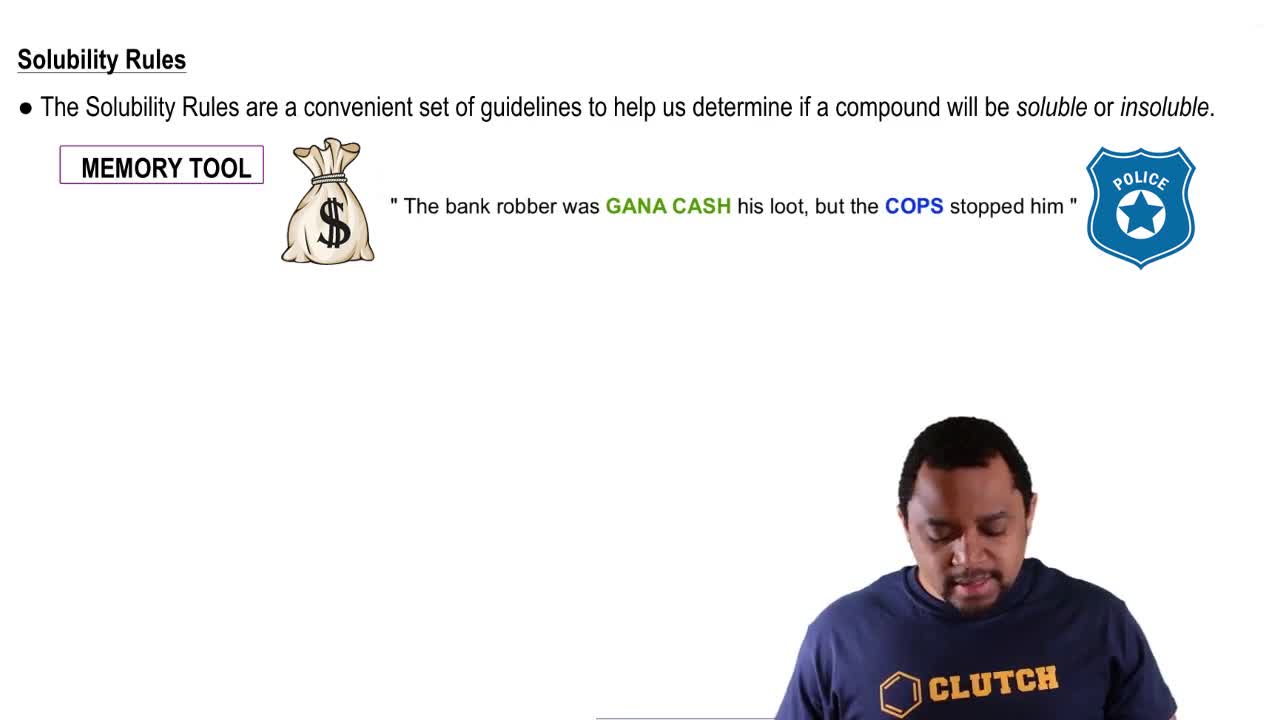
Solubility rules are guidelines that help predict whether an ionic compound will dissolve in water. These rules indicate that certain ions, such as alkali metals and nitrates, generally form soluble compounds, while others, like carbonates and phosphates, are often insoluble. Familiarity with these rules is crucial for determining the solubility of specific compounds, such as BaCO₃.
Barium carbonate (BaCO₃) is an ionic compound composed of barium cations (Ba²⁺) and carbonate anions (CO₃²⁻). According to solubility rules, most carbonates are insoluble in water, with the exception of those containing alkali metals or ammonium. Therefore, BaCO₃ is generally considered insoluble in water, which is important for predicting its behavior in aqueous solutions.