The refrigerant 1,1,1,2-tetrafluoroethane has been used in air conditioners in cars since the mid-1990s, but is being phased out due to its environmental impact. Draw the skeletal structure for this compound.
Verified step by step guidance
1
Identify the molecular formula of 1,1,1,2-tetrafluoroethane, which is C2H2F4.
Recognize that the compound is a derivative of ethane (C2H6), where four hydrogen atoms are replaced by fluorine atoms.
Draw the carbon backbone: two carbon atoms connected by a single bond (C-C).
Attach the hydrogen atoms: one hydrogen atom to each carbon atom.
Attach the fluorine atoms: three fluorine atoms to the first carbon and one fluorine atom to the second carbon.
Verified video answer for a similar problem:
This video solution was recommended by our tutors as helpful for the problem above
Video duration:
1m
Play a video:
Was this helpful?
Key Concepts
Here are the essential concepts you must grasp in order to answer the question correctly.
Skeletal Structure
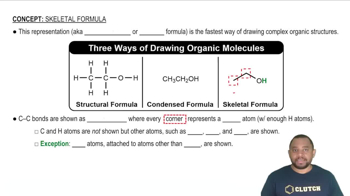
A skeletal structure is a simplified representation of a chemical compound that shows the arrangement of atoms and bonds without depicting all the hydrogen atoms explicitly. In skeletal formulas, carbon atoms are represented by vertices or ends of lines, while bonds between them are shown as lines. This method allows chemists to visualize complex molecules more easily and is particularly useful for organic compounds.
Refrigerants are substances used in cooling systems, such as air conditioners and refrigerators, to absorb heat and provide cooling. They undergo phase changes from liquid to gas and back, facilitating heat transfer. The choice of refrigerant is crucial due to its efficiency, safety, and environmental impact, as some refrigerants can contribute to ozone depletion and global warming.
Environmental Impact of Chemicals
The environmental impact of chemicals refers to the effects that chemical substances have on ecosystems, human health, and the atmosphere. Compounds like 1,1,1,2-tetrafluoroethane can contribute to greenhouse gas emissions and ozone layer depletion, prompting regulatory actions to phase out harmful substances. Understanding these impacts is essential for developing sustainable alternatives and protecting the environment.