What is the role of bile salts in lipid digestion?
Verified step by step guidance
1
Bile salts are amphipathic molecules, meaning they have both hydrophilic (water-attracting) and hydrophobic (water-repelling) regions. This property allows them to interact with lipids and water simultaneously.
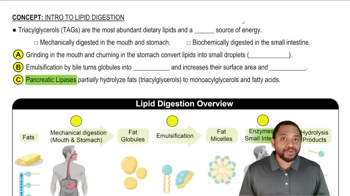
During lipid digestion, bile salts emulsify large fat globules into smaller droplets. This process increases the surface area of lipids, making them more accessible to digestive enzymes.
The smaller lipid droplets formed by bile salts are called micelles. These micelles help transport lipids through the aqueous environment of the digestive system.
Bile salts facilitate the action of lipase, an enzyme that breaks down triglycerides into glycerol and free fatty acids. Lipase works more efficiently on the emulsified lipid droplets.
After digestion, bile salts assist in the absorption of fatty acids and glycerol by forming micelles that transport these molecules to the intestinal lining for uptake into the bloodstream.
Verified video answer for a similar problem:
This video solution was recommended by our tutors as helpful for the problem above
Video duration:
1m
Play a video:
Was this helpful?
Key Concepts
Here are the essential concepts you must grasp in order to answer the question correctly.
Bile Salts
Bile salts are amphipathic molecules derived from cholesterol, produced in the liver and stored in the gallbladder. They play a crucial role in emulsifying dietary fats in the small intestine, breaking down large fat globules into smaller droplets, which increases the surface area for digestive enzymes to act upon.
Lipid digestion refers to the biochemical process by which dietary fats are broken down into fatty acids and glycerol. This process involves the action of enzymes, primarily pancreatic lipase, which work more effectively in the presence of bile salts that facilitate the emulsification of fats.
Emulsification is the process of breaking down fat globules into smaller, more manageable droplets, allowing for better interaction with digestive enzymes. Bile salts aid in this process by reducing the surface tension of fat droplets, enabling enzymes to access and digest the lipids more efficiently.