Fats and oils are both triglycerides. Consider the shortening Crisco®. Would scientists consider this a fat or an oil? What about margarine?
Verified step by step guidance
1
Understand that both fats and oils are types of triglycerides, which are esters derived from glycerol and three fatty acids.
Recognize that the primary difference between fats and oils is their state at room temperature: fats are solid, while oils are liquid.
Consider the composition of Crisco®, which is a type of shortening. Shortenings are typically solid at room temperature, indicating they are fats.
Examine margarine, which is also solid at room temperature, suggesting it is classified as a fat. However, margarine is often made from hydrogenated vegetable oils, which are originally liquid oils that have been chemically altered to become solid.
Conclude that both Crisco® and margarine are considered fats due to their solid state at room temperature, despite their different origins and processing methods.
Verified video answer for a similar problem:
This video solution was recommended by our tutors as helpful for the problem above
Video duration:
1m
Play a video:
Was this helpful?
Key Concepts
Here are the essential concepts you must grasp in order to answer the question correctly.
Triglycerides
Triglycerides are the main constituents of body fat in humans and animals, as well as vegetable fat. They are composed of glycerol and three fatty acids, which can vary in saturation. The structure of the fatty acids determines whether a triglyceride is classified as a fat (solid at room temperature) or an oil (liquid at room temperature).
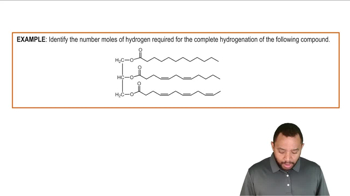
Triacylglycerol Reactions: Hydrogenation Example 1
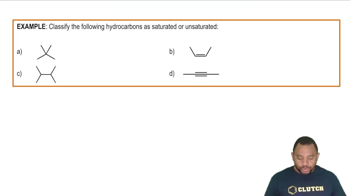
Saturation
Saturation refers to the presence of double bonds in the fatty acid chains of triglycerides. Saturated fats have no double bonds, making them solid at room temperature, while unsaturated fats contain one or more double bonds, resulting in a liquid state. This distinction is crucial for classifying substances like Crisco® and margarine.
Culinary applications refer to how fats and oils are used in cooking and food preparation. Crisco® is often used as a shortening, which is a solid fat that provides texture and moisture in baked goods, while margarine, which can be a blend of fats, is used as a butter substitute. Understanding these applications helps in determining whether a product is categorized as a fat or an oil.