Identify each of the following as a fatty acid, soap, triacylglycerol, wax, glycerophospholipid, sphingolipid, or steroid: a. beeswax
Verified step by step guidance
1
Step 1: Understand the question. The problem asks you to classify 'beeswax' into one of the given categories: fatty acid, soap, triacylglycerol, wax, glycerophospholipid, sphingolipid, or steroid. Each category represents a specific type of lipid or related compound.
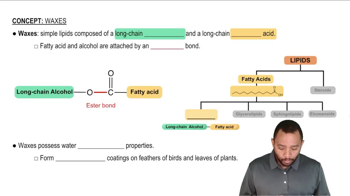
Step 2: Recall the definition of a wax. Waxes are esters formed from a long-chain fatty acid and a long-chain alcohol. They are hydrophobic and often serve as protective coatings in nature, such as on leaves, fruits, or animal products like beeswax.
Step 3: Identify the composition of beeswax. Beeswax is primarily composed of esters of fatty acids and long-chain alcohols, which matches the definition of a wax.
Step 4: Eliminate other options. Beeswax is not a fatty acid (a carboxylic acid with a long hydrocarbon chain), soap (a salt of a fatty acid), triacylglycerol (a glycerol molecule esterified with three fatty acids), glycerophospholipid (a lipid containing a phosphate group), sphingolipid (a lipid containing a sphingosine backbone), or steroid (a compound with a four-ring structure).
Step 5: Conclude that beeswax is classified as a wax based on its chemical structure and properties.
Verified video answer for a similar problem:
This video solution was recommended by our tutors as helpful for the problem above
Video duration:
2m
Play a video:
Was this helpful?
Key Concepts
Here are the essential concepts you must grasp in order to answer the question correctly.
Waxes
Waxes are long-chain fatty acids esterified to long-chain alcohols. They are solid at room temperature and serve various functions, including waterproofing and protection in plants and animals. Beeswax, for example, is produced by honeybees and is used to build honeycombs, showcasing its structural and protective properties.
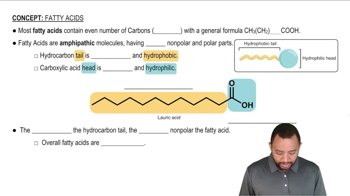
Fatty acids are carboxylic acids with long hydrocarbon chains, which can be saturated or unsaturated. They are key components of lipids and play crucial roles in energy storage, cellular structure, and signaling. Understanding the structure and properties of fatty acids is essential for categorizing various lipid types.
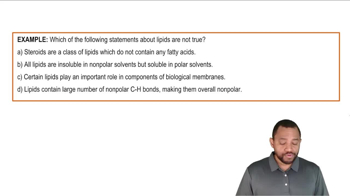
Lipids are a diverse group of hydrophobic organic molecules, including fats, oils, waxes, and steroids. They are essential for various biological functions, such as energy storage, membrane structure, and signaling. Recognizing the different classes of lipids helps in identifying their roles and characteristics in biological systems.


 2:58 minutes
 Verified step by step guidance
 1:37
1:37