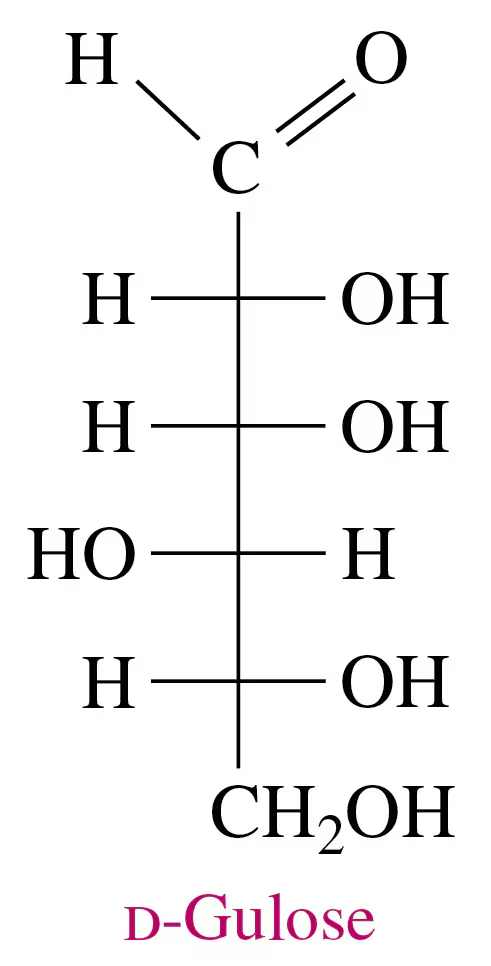
The sugar d-gulose is a sweet-tasting syrup. a. Draw the Fischer projection for L-gulose.
Verified step by step guidance
1
Understand the concept of enantiomers: d-gulose and l-gulose are enantiomers, meaning they are non-superimposable mirror images of each other. The difference lies in the arrangement of the hydroxyl (-OH) groups around the chiral carbons.
Start with the Fischer projection of d-gulose. In a Fischer projection, the carbon chain is drawn vertically, with the most oxidized carbon (the aldehyde group in this case) at the top. The horizontal lines represent bonds coming out of the plane (toward the viewer), and the vertical lines represent bonds going into the plane (away from the viewer).
To draw l-gulose, invert the configuration of all chiral centers in d-gulose. This means that for every chiral carbon, if the hydroxyl group is on the right in d-gulose, it will be on the left in l-gulose, and vice versa.
Ensure that the overall structure of l-gulose maintains the same number of carbons and functional groups as d-gulose. The aldehyde group remains at the top, and the hydroxyl and hydrogen groups alternate positions along the chain.
Double-check your drawing to confirm that it is a mirror image of d-gulose and that all chiral centers have been inverted. This ensures that the structure you have drawn is indeed l-gulose.
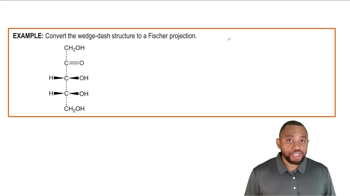
Verified video answer for a similar problem:
This video solution was recommended by our tutors as helpful for the problem above
Video duration:
2m
Play a video:
Was this helpful?
Key Concepts
Here are the essential concepts you must grasp in order to answer the question correctly.
Fischer Projection
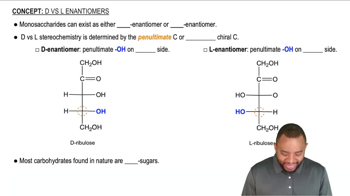
The Fischer projection is a two-dimensional representation of a three-dimensional organic molecule, particularly useful for depicting the stereochemistry of carbohydrates. In this format, the carbon chain is arranged vertically, with the most oxidized carbon at the top. Horizontal lines represent bonds that project out of the plane towards the viewer, while vertical lines indicate bonds that extend behind the plane.
Stereochemistry refers to the study of the spatial arrangement of atoms in molecules and how this affects their chemical properties and reactions. In sugars, stereochemistry is crucial because different configurations of the same molecular formula can lead to different biological activities and sweetness levels. For example, d-gulose and l-gulose are stereoisomers, differing in the orientation of hydroxyl groups around their chiral centers.
Chirality is a property of a molecule that makes it non-superimposable on its mirror image, much like left and right hands. In carbohydrates, chirality arises from carbon atoms that are bonded to four different substituents, creating chiral centers. The distinction between l- and d- forms of sugars is based on the configuration at the chiral center furthest from the aldehyde or ketone group, which is essential for understanding their structure and function.