Draw the Fischer projections for D-glucose and L-glucose.
Verified step by step guidance
1
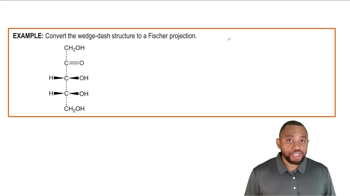
Understand the Fischer projection: It is a two-dimensional representation of a molecule where the vertical lines represent bonds going away from the viewer (into the plane), and the horizontal lines represent bonds coming toward the viewer (out of the plane). For sugars, the carbon chain is drawn vertically with the most oxidized carbon (the aldehyde group in glucose) at the top.
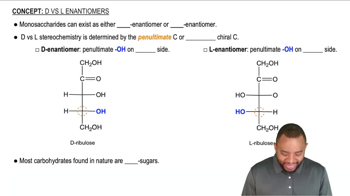
Identify the structure of D-glucose: D-glucose is an aldohexose (a six-carbon sugar with an aldehyde group). The hydroxyl (-OH) groups on the chiral carbons are arranged as follows: on carbon 2, the -OH is on the right; on carbon 3, the -OH is on the left; on carbon 4, the -OH is on the right; and on carbon 5, the -OH is on the right. The -CH2OH group on carbon 5 determines the D-configuration because it is on the same side as the -OH group on the last chiral carbon.
Draw the Fischer projection for D-glucose: Start with the aldehyde group (CHO) at the top. Then, draw the vertical chain of carbons with the hydroxyl groups arranged as described in step 2. The bottom carbon (C6) will have the -CH2OH group pointing to the right.
Identify the structure of L-glucose: L-glucose is the enantiomer of D-glucose. This means that all the chiral centers in L-glucose have the opposite configuration compared to D-glucose. For L-glucose, the -OH groups are arranged as follows: on carbon 2, the -OH is on the left; on carbon 3, the -OH is on the right; on carbon 4, the -OH is on the left; and on carbon 5, the -OH is on the left. The -CH2OH group on carbon 5 determines the L-configuration because it is on the opposite side of the -OH group on the last chiral carbon.
Draw the Fischer projection for L-glucose: Start with the aldehyde group (CHO) at the top. Then, draw the vertical chain of carbons with the hydroxyl groups arranged as described in step 4. The bottom carbon (C6) will have the -CH2OH group pointing to the left.
Verified video answer for a similar problem:
This video solution was recommended by our tutors as helpful for the problem above
Video duration:
3m
Play a video:
Was this helpful?
Key Concepts
Here are the essential concepts you must grasp in order to answer the question correctly.
Fischer Projections
Fischer projections are a two-dimensional representation of three-dimensional organic molecules, particularly useful for depicting the stereochemistry of carbohydrates and amino acids. In these projections, vertical lines represent bonds that extend away from the viewer, while horizontal lines represent bonds that come towards the viewer. This format allows for easy visualization of the spatial arrangement of substituents around a chiral center.
The D and L designations refer to the configuration of chiral centers in sugars and amino acids, based on the orientation of the hydroxyl group (-OH) on the penultimate carbon (the second-to-last carbon). D-glucose has the hydroxyl group on the right side in its Fischer projection, while L-glucose has it on the left. This classification is crucial for understanding the biological roles and reactivity of these molecules.
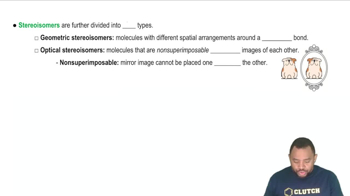
Stereoisomerism is a form of isomerism where molecules have the same molecular formula and connectivity but differ in the spatial arrangement of their atoms. In carbohydrates like glucose, stereoisomers can have different physical and chemical properties, influencing their biological functions. Understanding stereoisomerism is essential for drawing accurate Fischer projections and recognizing the significance of D and L forms in biochemistry.