How does the ideal gas law differ from the combined gas law?
Verified step by step guidance
1
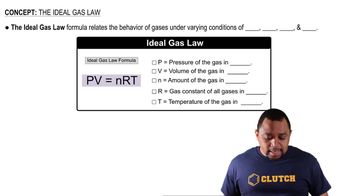
The ideal gas law is expressed as , where P is pressure, V is volume, n is the number of moles of gas, R is the ideal gas constant, and T is temperature. It relates these variables to describe the behavior of an ideal gas.
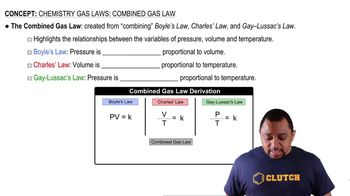
The combined gas law is expressed as , which shows the relationship between pressure, volume, and temperature for a fixed amount of gas. It is derived from Boyle's, Charles's, and Gay-Lussac's laws.
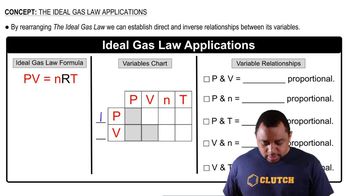
The key difference is that the ideal gas law includes the number of moles (n) and the gas constant (R), making it applicable to situations where the quantity of gas is variable. The combined gas law assumes a constant amount of gas and does not include n or R.
The ideal gas law is more general and can be used to calculate properties of a gas when the amount of gas is known or needs to be determined. The combined gas law is typically used when comparing the same gas under two different sets of conditions, assuming the amount of gas remains constant.
In summary, the ideal gas law is a more comprehensive equation that includes the quantity of gas, while the combined gas law is a simplified version that focuses on the relationship between pressure, volume, and temperature for a fixed amount of gas.
Verified video answer for a similar problem:
This video solution was recommended by our tutors as helpful for the problem above
Video duration:
2m
Play a video:
Was this helpful?
Key Concepts
Here are the essential concepts you must grasp in order to answer the question correctly.
Ideal Gas Law
The Ideal Gas Law is a fundamental equation in thermodynamics that relates the pressure, volume, temperature, and number of moles of an ideal gas. It is expressed as PV = nRT, where P is pressure, V is volume, n is the number of moles, R is the ideal gas constant, and T is temperature in Kelvin. This law assumes that gas particles do not interact and occupy no volume, making it applicable under ideal conditions.
The Combined Gas Law is a formulation that combines Boyle's Law, Charles's Law, and Gay-Lussac's Law into a single equation. It expresses the relationship between pressure, volume, and temperature of a fixed amount of gas, represented as (P1V1)/T1 = (P2V2)/T2. This law is useful for comparing the states of a gas when the amount of gas remains constant, allowing for the analysis of changes in one variable while the others are adjusted.
The primary difference between the Ideal Gas Law and the Combined Gas Law lies in their applications. The Ideal Gas Law can be used to calculate the state of an ideal gas under various conditions, including changes in the number of moles. In contrast, the Combined Gas Law is specifically used for scenarios where the amount of gas is constant, focusing on how pressure, volume, and temperature interrelate during changes in state.