Sketch an energy diagram for a system in which the forward reaction has Eact = +25 kcal/mol (+105 kJ/mol) and the reverse reaction has Eact = +35 kcal/mol (+146 kJ/mol). a. Is the forward process endergonic or exergonic?
Verified step by step guidance
1
Step 1: Understand the energy diagram. An energy diagram plots the energy of a system as the reaction progresses from reactants to products. The activation energy (E_act) is the energy barrier that must be overcome for the reaction to proceed. The difference in energy between reactants and products determines whether the reaction is endergonic or exergonic.
Step 2: Identify the given data. The forward reaction has an activation energy (E_act) of +25 kcal/mol (+105 kJ/mol), and the reverse reaction has an activation energy (E_act) of +35 kcal/mol (+146 kJ/mol). This means the energy difference between the reactants and products can be calculated by subtracting the forward activation energy from the reverse activation energy.
Step 3: Calculate the energy difference between reactants and products. The energy difference (ΔE) is given by ΔE = E_act(reverse) - E_act(forward). Substitute the given values into the equation: ΔE = 35 kcal/mol - 25 kcal/mol (or ΔE = 146 kJ/mol - 105 kJ/mol). This will give the energy change for the reaction.
Step 4: Determine if the forward reaction is endergonic or exergonic. If ΔE is negative, the forward reaction releases energy and is exergonic. If ΔE is positive, the forward reaction absorbs energy and is endergonic.
Step 5: Sketch the energy diagram. On the y-axis, label 'Energy,' and on the x-axis, label 'Reaction Progress.' Draw a curve starting at the energy level of the reactants, peaking at the activation energy for the forward reaction (+25 kcal/mol), and ending at the energy level of the products. The difference in energy between the reactants and products corresponds to ΔE. Also, include the reverse activation energy (+35 kcal/mol) as the peak from the products back to the reactants.
Verified video answer for a similar problem:
This video solution was recommended by our tutors as helpful for the problem above
Video duration:
5m
Play a video:
Was this helpful?
Key Concepts
Here are the essential concepts you must grasp in order to answer the question correctly.
Activation Energy (E_act)
Activation energy is the minimum energy required for a chemical reaction to occur. It represents the energy barrier that reactants must overcome to transform into products. In this question, the forward reaction has an activation energy of +25 kcal/mol, while the reverse reaction has a higher activation energy of +35 kcal/mol, indicating that the reverse reaction is more difficult to initiate.
Endergonic reactions absorb energy from their surroundings, resulting in a positive change in Gibbs free energy (ΔG > 0), while exergonic reactions release energy, leading to a negative change in Gibbs free energy (ΔG < 0). To determine whether the forward process is endergonic or exergonic, one must analyze the energy difference between reactants and products, which is not directly provided but can be inferred from the activation energies.
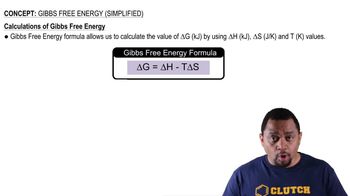
Gibbs free energy is a thermodynamic potential that measures the maximum reversible work obtainable from a thermodynamic system at constant temperature and pressure. It is crucial for predicting the spontaneity of a reaction. If the Gibbs free energy change (ΔG) for a reaction is negative, the reaction is spontaneous (exergonic); if positive, it is non-spontaneous (endergonic). The relationship between activation energies and the overall energy change helps in determining the nature of the reaction.