Draw the condensed structural formula for each of the following alkanes: d. 1-bromo-2-chloroethane
Verified step by step guidance
1
Step 1: Understand the structure of the parent alkane. The parent alkane here is 'ethane,' which has the molecular formula C₂H₆. Ethane consists of two carbon atoms connected by a single bond, with each carbon atom bonded to enough hydrogen atoms to satisfy the octet rule.
Step 2: Identify the substituents and their positions. The name '1-bromo-2-chloroethane' indicates that there are two substituents: a bromine (Br) atom attached to the first carbon and a chlorine (Cl) atom attached to the second carbon.
Step 3: Replace the appropriate hydrogen atoms with the substituents. In ethane, each carbon atom is initially bonded to three hydrogen atoms. For 1-bromo-2-chloroethane, replace one hydrogen atom on the first carbon with a bromine atom and one hydrogen atom on the second carbon with a chlorine atom.
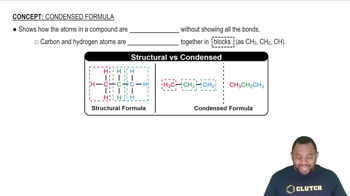
Step 4: Write the condensed structural formula. A condensed structural formula represents the molecule in a compact form, showing the arrangement of atoms. For this molecule, the first carbon will be written as CH₂Br (since it is bonded to two hydrogens and one bromine), and the second carbon will be written as CHCl (since it is bonded to one hydrogen and one chlorine).
Step 5: Combine the parts to form the complete condensed structural formula. Join the two carbon groups (CH₂Br and CHCl) with a single bond to represent the ethane backbone, resulting in the condensed structural formula for 1-bromo-2-chloroethane.
Verified video answer for a similar problem:
This video solution was recommended by our tutors as helpful for the problem above
Play a video:
Was this helpful?
Key Concepts
Here are the essential concepts you must grasp in order to answer the question correctly.
Alkanes
Alkanes are saturated hydrocarbons consisting only of carbon (C) and hydrogen (H) atoms, connected by single bonds. They follow the general formula CnH2n+2, where 'n' is the number of carbon atoms. Understanding alkanes is essential for drawing their structural formulas, as it provides the foundational knowledge of how carbon atoms bond and the resulting molecular structure.
A condensed structural formula is a way of representing a chemical compound that shows the arrangement of atoms in a molecule without depicting all the bonds explicitly. It typically groups atoms together to indicate how they are connected, making it easier to visualize the structure of complex molecules. For alkanes and their derivatives, this format helps in quickly identifying functional groups and substituents.
Substituents are atoms or groups of atoms that replace hydrogen atoms in a hydrocarbon chain. In the case of 1-bromo-2-chloroethane, the substituents are bromine (Br) and chlorine (Cl) atoms attached to the ethane backbone. Recognizing the position and type of substituents is crucial for accurately drawing the condensed structural formula and understanding the compound's reactivity and properties.