Draw the structural formula for each of the following peptides: b. KCG
Verified step by step guidance
1
Identify the amino acids in the peptide sequence 'KCG'. The sequence represents lysine (K), cysteine (C), and glycine (G). Each amino acid has a specific structure: lysine has a side chain with an amino group, cysteine has a thiol (-SH) group, and glycine has a hydrogen atom as its side chain.
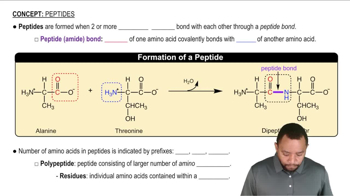
Understand the peptide bond formation. Peptide bonds are formed between the carboxyl group (-COOH) of one amino acid and the amino group (-NH2) of the next amino acid, releasing a molecule of water (H2O) in the process.
Draw the backbone of the peptide. Start with the N-terminal (amino group of lysine) and connect the amino acids in the order K-C-G. The backbone will consist of repeating units of -NH-CH(R)-CO-, where R represents the side chain of each amino acid.
Add the side chains to the backbone. For lysine (K), attach the side chain (-CH2-CH2-CH2-CH2-NH2) to the alpha carbon. For cysteine (C), attach the thiol group (-SH) to the alpha carbon. For glycine (G), the side chain is simply a hydrogen atom.
Ensure the structure is complete and correct. Verify that the N-terminal (lysine) has a free amino group (-NH2) and the C-terminal (glycine) has a free carboxyl group (-COOH). Double-check the connectivity and orientation of the peptide bonds and side chains.
Verified video answer for a similar problem:
This video solution was recommended by our tutors as helpful for the problem above
Video duration:
5m
Play a video:
Was this helpful?
Key Concepts
Here are the essential concepts you must grasp in order to answer the question correctly.
Peptide Structure
Peptides are short chains of amino acids linked by peptide bonds. The structure of a peptide is determined by the sequence of its constituent amino acids, which influences its properties and functions. Understanding the basic structure of peptides is essential for drawing their structural formulas.
Amino acids are the building blocks of peptides and proteins, each containing an amino group, a carboxyl group, and a unique side chain (R group). The specific sequence of amino acids in a peptide determines its identity and characteristics. In the case of the peptide KCG, the amino acids involved are lysine (K), cysteine (C), and glycine (G).
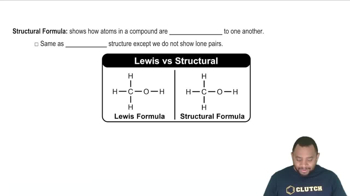
The structural formula of a peptide visually represents the arrangement of atoms and the bonds between them. It includes the backbone of the peptide, which consists of the repeating units of amino acids, and highlights the side chains. Accurately drawing the structural formula requires knowledge of how to depict peptide bonds and the orientation of the amino acids.