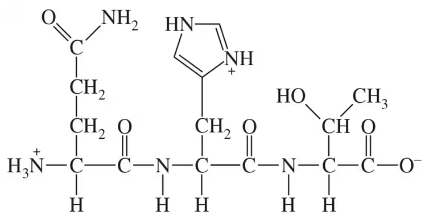
Consider the following tripeptide: a. Circle the N-terminal amino acid, and give its name. Draw a square around the C-terminal amino acid, and give its name.
Verified step by step guidance
1
Step 1: Understand the structure of a tripeptide. A tripeptide consists of three amino acids linked by peptide bonds. The N-terminal amino acid is the one with a free amino group (-NH2), while the C-terminal amino acid is the one with a free carboxyl group (-COOH).
Step 2: Examine the provided image of the tripeptide. Identify the amino acid at the N-terminal (leftmost side of the structure) by locating the free amino group (-NH2). Circle this amino acid and note its name based on its side chain and structure.
Step 3: Identify the amino acid at the C-terminal (rightmost side of the structure) by locating the free carboxyl group (-COOH). Draw a square around this amino acid and note its name based on its side chain and structure.
Step 4: For the middle amino acid, observe its structure and confirm that it is connected to the N-terminal and C-terminal amino acids via peptide bonds. This amino acid does not have free amino or carboxyl groups.
Step 5: Review the names of the N-terminal and C-terminal amino acids you identified, ensuring they match the structural features and side chains visible in the image.
Verified video answer for a similar problem:
This video solution was recommended by our tutors as helpful for the problem above
Video duration:
3m
Play a video:
Was this helpful?
Key Concepts
Here are the essential concepts you must grasp in order to answer the question correctly.
N-terminal and C-terminal
The N-terminal refers to the end of a peptide or protein that has a free amino group (-NH2), while the C-terminal is the end with a free carboxyl group (-COOH). In a tripeptide, the N-terminal amino acid is the first in the sequence, and the C-terminal is the last. Identifying these ends is crucial for understanding the structure and function of peptides.
Amino acids are the building blocks of proteins and peptides, consisting of a central carbon atom, an amino group, a carboxyl group, a hydrogen atom, and a variable side chain (R group). Each amino acid has a unique side chain that determines its properties and role in protein structure. Recognizing the specific amino acids at the N- and C-termini is essential for understanding the peptide's characteristics.
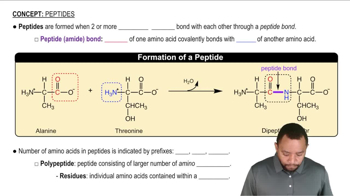
Peptides are short chains of amino acids linked by peptide bonds, formed through a dehydration reaction between the amino group of one amino acid and the carboxyl group of another. The sequence and arrangement of amino acids in a peptide dictate its three-dimensional structure and biological function. Understanding peptide structure is vital for analyzing how the N- and C-terminal amino acids influence the overall properties of the tripeptide.