Understand the role of tRNA (transfer RNA): tRNA molecules are responsible for bringing amino acids to the ribosome during protein synthesis. Each tRNA has an anticodon that pairs with a specific codon on the mRNA strand.
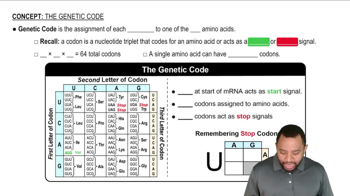
Recognize the genetic code: The genetic code consists of 64 codons, each made up of three nucleotides. These codons correspond to 20 amino acids, as well as start and stop signals for translation.
Explain the need for at least 20 tRNAs: Since there are 20 amino acids used in protein synthesis, there must be at least 20 tRNAs to ensure that each amino acid is matched with its corresponding codon on the mRNA.
Discuss wobble pairing: Some tRNAs can recognize multiple codons due to 'wobble' at the third position of the codon. This reduces the total number of tRNAs needed but still requires at least 20 to cover all amino acids.
Conclude with the importance of specificity: The specificity of tRNA anticodons ensures accurate translation of the genetic code into proteins, which is essential for proper cellular function.
Verified video answer for a similar problem:
This video solution was recommended by our tutors as helpful for the problem above
Video duration:
1m
Play a video:
Was this helpful?
Key Concepts
Here are the essential concepts you must grasp in order to answer the question correctly.
tRNA Structure and Function
Transfer RNA (tRNA) is a type of RNA molecule that plays a crucial role in translating the genetic code into proteins. Each tRNA molecule carries a specific amino acid and has an anticodon that pairs with the corresponding codon on mRNA during protein synthesis. This ensures that the correct amino acids are added in the proper sequence to form proteins.
The genetic code consists of sequences of three nucleotides (codons) that correspond to specific amino acids. Since there are 64 possible codons (4 nucleotides raised to the power of 3), but only 20 standard amino acids, multiple codons can code for the same amino acid. This redundancy necessitates a diverse set of tRNAs to ensure accurate translation of the genetic information.
The wobble hypothesis explains how some tRNAs can recognize more than one codon due to flexible base pairing at the third position of the codon. This allows a limited number of tRNA molecules to accommodate the vast array of codons, but still requires a minimum of 20 distinct tRNAs to cover all amino acids effectively, ensuring efficient and accurate protein synthesis.