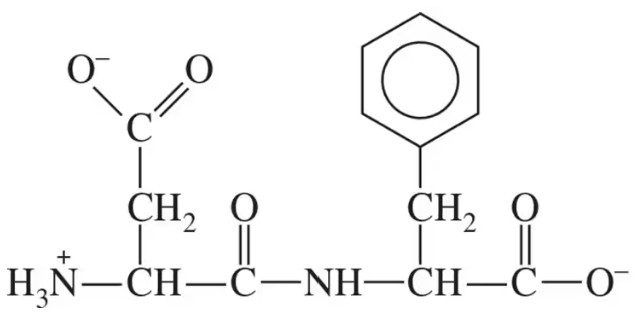
Aspartame, which is commonly known as NutraSweet™, contains the following dipeptide: d. Draw the structure of the isomer of this dipeptide where the C-terminal and N-terminal amino acids are switched.
Verified step by step guidance
1
Understand the structure of a dipeptide: A dipeptide consists of two amino acids linked by a peptide bond. The N-terminal amino acid has a free amino group (-NH2), and the C-terminal amino acid has a free carboxyl group (-COOH).
Identify the original structure of the dipeptide in Aspartame: The dipeptide in Aspartame is composed of phenylalanine and aspartic acid. Determine which amino acid is at the N-terminal and which is at the C-terminal in the given structure.
Switch the positions of the amino acids: To create the isomer, reverse the positions of the N-terminal and C-terminal amino acids. This means the amino acid that was originally at the N-terminal will now be at the C-terminal, and vice versa.
Redraw the peptide bond: Ensure that the peptide bond (-CO-NH-) is correctly formed between the carboxyl group of the new N-terminal amino acid and the amino group of the new C-terminal amino acid.
Verify the structure: Double-check that the new structure maintains the correct connectivity of atoms and functional groups, and that the amino acids are properly oriented with their side chains intact.
Verified video answer for a similar problem:
This video solution was recommended by our tutors as helpful for the problem above
Video duration:
4m
Play a video:
Was this helpful?
Key Concepts
Here are the essential concepts you must grasp in order to answer the question correctly.
Dipeptides
Dipeptides are molecules formed by the condensation of two amino acids, linked by a peptide bond. The sequence and identity of the amino acids determine the properties and function of the dipeptide. Understanding the structure of dipeptides is crucial for analyzing their behavior in biological systems, including their role in sweeteners like aspartame.
Isomerism refers to the phenomenon where two or more compounds have the same molecular formula but different structural arrangements. In the context of dipeptides, switching the C-terminal and N-terminal amino acids creates an isomer, which can have different properties and biological activities. Recognizing isomers is essential for understanding how slight changes in structure can affect function.
Amino acids are the building blocks of proteins, each consisting of a central carbon atom, an amino group, a carboxyl group, a hydrogen atom, and a variable R group. The specific arrangement of these groups determines the identity and characteristics of the amino acid. Knowledge of amino acid structures is vital for drawing and manipulating peptide structures, including dipeptides.