Select the container that represents the dilution of a 4% (m/v) KCl solution to give each of the following: a. a 2% (m/v) KCl solution <IMAGE>
Verified step by step guidance
1
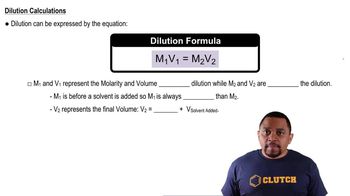
Step 1: Understand the concept of dilution. Dilution involves reducing the concentration of a solution by adding more solvent. The formula used for dilution is \( C_1V_1 = C_2V_2 \), where \( C_1 \) and \( C_2 \) are the initial and final concentrations, and \( V_1 \) and \( V_2 \) are the initial and final volumes.
Step 2: Identify the given values. The initial concentration \( C_1 \) is 4% (m/v), and the final concentration \( C_2 \) is 2% (m/v). You need to determine the volume of the original solution \( V_1 \) required to prepare the diluted solution.
Step 3: Rearrange the dilution formula to solve for \( V_1 \): \( V_1 = \frac{C_2V_2}{C_1} \). Here, \( V_2 \) represents the total volume of the diluted solution.
Step 4: Analyze the image provided. The container shown represents a solution with a specific volume. If the container is labeled or has markings indicating the total volume, use that value as \( V_2 \). If no markings are visible, assume the container's volume is the total volume of the diluted solution.
Step 5: Substitute the known values into the formula \( V_1 = \frac{C_2V_2}{C_1} \) to calculate the volume of the original 4% solution needed. Ensure the units are consistent throughout the calculation (e.g., mL or L).
Verified video answer for a similar problem:
This video solution was recommended by our tutors as helpful for the problem above
Video duration:
1m
Play a video:
Was this helpful?
Key Concepts
Here are the essential concepts you must grasp in order to answer the question correctly.
Dilution
Dilution is the process of reducing the concentration of a solute in a solution, typically by adding more solvent. In this context, diluting a 4% (m/v) KCl solution to a 2% (m/v) solution involves adding a specific volume of solvent to decrease the concentration of potassium chloride in the solution.
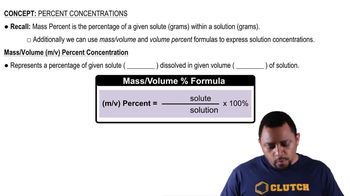
Mass/Volume Percent (m/v) is a way to express the concentration of a solution, defined as the mass of solute (in grams) per 100 mL of solution. For example, a 4% (m/v) KCl solution contains 4 grams of KCl in every 100 mL of solution, while a 2% (m/v) solution contains 2 grams of KCl in the same volume.
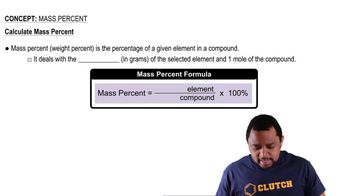
Concentration calculation involves determining the amount of solute and solvent needed to achieve a desired concentration. To dilute a solution from 4% to 2%, one must calculate the appropriate volumes of the original solution and solvent required, ensuring the final concentration meets the target specifications.