Give the structure and name of the cycloalkanes described. (a) A compound whose molecular formula is C6H12 and contains a five-membered ring
Verified step by step guidance
1
Step 1: Understand the molecular formula C₆H₁₂. This indicates the compound is a cycloalkane, as it follows the general formula for cycloalkanes, CₙH₂ₙ.
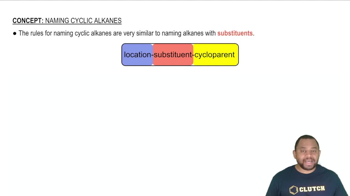
Step 2: Recognize that the problem specifies a five-membered ring. Cycloalkanes are named based on the number of carbon atoms in the ring structure. A five-membered ring corresponds to cyclopentane.
Step 3: Draw the structure of cyclopentane. Represent a pentagon to indicate the five-membered ring, with each vertex representing a carbon atom. Add two hydrogen atoms to each carbon to satisfy the molecular formula C₆H₁₂.
Step 4: Verify the molecular formula by counting the total number of carbon and hydrogen atoms in the structure. Ensure there are 6 carbons and 12 hydrogens.
Step 5: Name the compound. Since it is a five-membered ring with no substituents, the name is simply 'cyclopentane'.
Verified video answer for a similar problem:
This video solution was recommended by our tutors as helpful for the problem above
Video duration:
3m
Play a video:
Was this helpful?
Key Concepts
Here are the essential concepts you must grasp in order to answer the question correctly.
Cycloalkanes
Cycloalkanes are a class of hydrocarbons that contain carbon atoms arranged in a ring structure. They are saturated compounds, meaning they have single bonds between carbon atoms and follow the general formula CnH2n, where n is the number of carbon atoms. Cycloalkanes can vary in size and complexity, with common examples including cyclopropane, cyclobutane, and cyclohexane.
A molecular formula represents the number and types of atoms in a molecule. For cycloalkanes, the molecular formula can help identify the number of carbon and hydrogen atoms present. In the case of C₆H₁₂, the formula indicates six carbon atoms and twelve hydrogen atoms, which is characteristic of a cycloalkane with a ring structure.
A five-membered ring in organic chemistry refers to a cyclic structure composed of five carbon atoms. This specific arrangement can lead to various isomers and derivatives, such as cyclopentane or methylcyclobutane. The presence of a five-membered ring in a compound with the formula C₆H₁₂ suggests that there may be additional substituents or branching in the structure, influencing its chemical properties.