Draw skeletal structures for each of the following molecules: (a) ethylcyclopropane
Verified step by step guidance
1
Step 1: Understand the molecular structure of ethylcyclopropane. Ethylcyclopropane consists of a cyclopropane ring (a three-membered ring of carbon atoms) with an ethyl group (-CH2CH3) attached to one of the carbon atoms in the ring.
Step 2: Begin by drawing the cyclopropane ring. Represent it as a triangle since it is a three-membered ring, with each vertex representing a carbon atom.
Step 3: Identify the attachment point for the ethyl group. Choose one of the carbon atoms in the cyclopropane ring to attach the ethyl group.
Step 4: Draw the ethyl group. Extend a bond from the chosen carbon atom in the cyclopropane ring and add two more carbon atoms to form the ethyl group (-CH2CH3). Ensure the correct number of hydrogen atoms are added to each carbon to satisfy the octet rule.
Step 5: Verify the skeletal structure. Ensure all carbon atoms have four bonds and the structure accurately represents ethylcyclopropane. The skeletal structure should only show the bonds between carbon atoms and omit hydrogen atoms for simplicity.
Verified video answer for a similar problem:
This video solution was recommended by our tutors as helpful for the problem above
Video duration:
2m
Play a video:
Was this helpful?
Key Concepts
Here are the essential concepts you must grasp in order to answer the question correctly.
Skeletal Structures
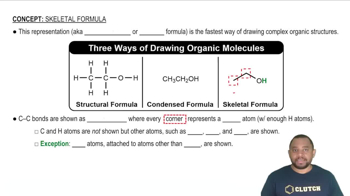
Skeletal structures, also known as line-angle formulas, are a simplified way of representing organic molecules. In these diagrams, carbon atoms are represented by the ends and intersections of lines, while hydrogen atoms are often omitted for clarity. This method allows chemists to visualize the connectivity and arrangement of atoms in a molecule without cluttering the diagram with every atom explicitly shown.
Cycloalkanes are a class of hydrocarbons that contain carbon atoms arranged in a ring structure. They are characterized by the formula CnH2n, where 'n' is the number of carbon atoms. Ethylcyclopropane specifically consists of a cyclopropane ring (three carbon atoms) with an ethyl group (two carbon atoms) attached, making it essential to understand how substituents affect the overall structure and stability of the molecule.
Substituents are atoms or groups of atoms that replace hydrogen atoms in a hydrocarbon chain or ring. In the case of ethylcyclopropane, the ethyl group acts as a substituent on the cyclopropane ring. Understanding how substituents influence the properties and reactivity of organic compounds is crucial for drawing accurate skeletal structures and predicting molecular behavior.