There are four amide isomers with the molecular formula C3H7NO. Draw their condensed structural formulas and write the IUPAC name for each.
Verified step by step guidance
1
Step 1: Understand the molecular formula C3H7NO. This formula indicates that the compound contains 3 carbon atoms, 7 hydrogen atoms, 1 nitrogen atom, and 1 oxygen atom. Since the problem specifies amide isomers, the functional group must include a carbonyl group (C=O) directly bonded to a nitrogen atom (N).
Step 2: Recall the general structure of an amide. Amides have the functional group R-CONH2, where R is a hydrocarbon group. For isomers, the arrangement of the carbon atoms and the placement of the functional group can vary while maintaining the same molecular formula.
Step 3: Draw the first isomer: Propanamide. This is the simplest arrangement where the carbon chain is unbranched, and the amide group is at the end. The condensed structural formula is CH3CH2CONH2, and the IUPAC name is propanamide.
Step 4: Draw the second isomer: N-Methylacetamide. In this structure, one hydrogen atom on the nitrogen is replaced by a methyl group. The condensed structural formula is CH3CONHCH3, and the IUPAC name is N-methylacetamide.
Step 5: Draw the third and fourth isomers: These involve branching of the carbon chain. For example, one isomer is 2-Methylpropanamide (CH3CH(CH3)CONH2), where a methyl group is attached to the second carbon of the chain. Another isomer is N-Ethylformamide (HCONHCH2CH3), where the nitrogen is bonded to an ethyl group. Write their condensed structural formulas and IUPAC names accordingly.
Verified video answer for a similar problem:
This video solution was recommended by our tutors as helpful for the problem above
Video duration:
8m
Play a video:
Was this helpful?
Key Concepts
Here are the essential concepts you must grasp in order to answer the question correctly.
Amide Isomers
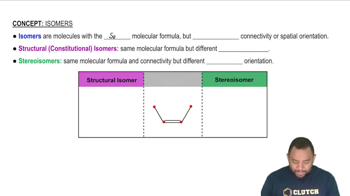
Amide isomers are compounds that share the same molecular formula but differ in the arrangement of atoms. For C3H7NO, the isomers can vary in the positioning of the carbonyl group and the nitrogen atom, leading to different structural forms. Understanding isomerism is crucial for identifying and naming these compounds accurately.
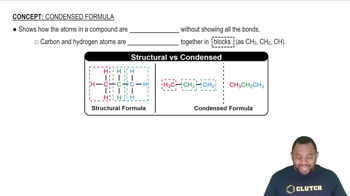
A condensed structural formula provides a simplified representation of a molecule, showing how atoms are connected without depicting all bonds explicitly. It is useful for visualizing the structure of isomers quickly. For amides, the formula typically indicates the presence of the carbonyl group (C=O) and the amine group (NH2) in a compact format.
IUPAC nomenclature is a systematic method for naming chemical compounds based on their structure and functional groups. For amides, the naming convention involves identifying the longest carbon chain, indicating the presence of the amide functional group, and using appropriate suffixes and prefixes. This ensures that each compound has a unique and universally accepted name.