Peptides isolated from rapeseed that may lower blood pressure have the following sequence of amino acids. Draw the structure for each peptide and write the one-letter abbreviations. a. Arg–Ile–Tyr
Verified step by step guidance
1
Step 1: Understand the problem. The task is to draw the structure of the peptide and write its one-letter abbreviation. A peptide is a chain of amino acids linked by peptide bonds. Each amino acid has a specific structure and a one-letter code.
Step 2: Identify the amino acids in the sequence. The sequence provided is Arg–Ile–Tyr. Arg stands for Arginine, Ile stands for Isoleucine, and Tyr stands for Tyrosine.
Step 3: Draw the structure of each amino acid. Use the general structure of amino acids, which includes an amino group (-NH₂), a carboxyl group (-COOH), a hydrogen atom, and a unique side chain (R group) attached to the central carbon (α-carbon). For each amino acid:
- Arginine (Arg) has a side chain with a guanidinium group.
- Isoleucine (Ile) has a branched alkyl side chain.
- Tyrosine (Tyr) has a phenol group as its side chain.
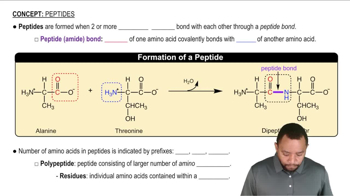
Step 4: Connect the amino acids using peptide bonds. A peptide bond is formed between the carboxyl group of one amino acid and the amino group of the next amino acid, releasing a molecule of water (condensation reaction). Connect Arg to Ile, and then Ile to Tyr.
Step 5: Write the one-letter abbreviations for the peptide sequence. The one-letter codes for the amino acids are: Arginine (R), Isoleucine (I), and Tyrosine (Y). Therefore, the one-letter abbreviation for the peptide is R-I-Y.
Verified video answer for a similar problem:
This video solution was recommended by our tutors as helpful for the problem above
Video duration:
1m
Play a video:
Was this helpful?
Key Concepts
Here are the essential concepts you must grasp in order to answer the question correctly.
Peptide Structure
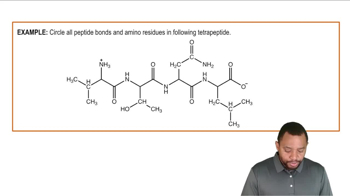
Peptides are short chains of amino acids linked by peptide bonds. The structure of a peptide is determined by the sequence of its amino acids, which influences its biological function. Understanding how to draw peptide structures involves knowing the general backbone of amino acids and how to represent side chains.
Amino acids are often represented by one-letter codes for simplicity in biochemical contexts. For example, Arginine is denoted as 'R', Isoleucine as 'I', and Tyrosine as 'Y'. Familiarity with these abbreviations is essential for efficiently communicating peptide sequences in scientific literature.
Peptides can have various biological functions, including acting as hormones, neurotransmitters, or signaling molecules. The specific sequence of amino acids in a peptide can influence its ability to interact with receptors and affect physiological processes, such as blood pressure regulation. Understanding these functions is crucial for interpreting the significance of the peptides derived from rapeseed.