Draw the condensed structural formula for each of the following peptides, and give its three-letter and one-letter abbreviations: d. histidylglycylglutamylisoleucine
Verified step by step guidance
1
Identify the amino acids in the peptide sequence: histidine (His), glycine (Gly), glutamic acid (Glu), and isoleucine (Ile). Note their three-letter and one-letter abbreviations: His (H), Gly (G), Glu (E), Ile (I).
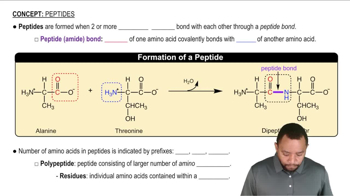
Understand the peptide bond formation: Peptides are formed by linking amino acids through peptide bonds, which occur between the carboxyl group of one amino acid and the amino group of the next amino acid.
Write the condensed structural formula for each amino acid: For example, histidine has the structure . Repeat this for glycine, glutamic acid, and isoleucine.
Link the amino acids in sequence: Start with histidine, then glycine, followed by glutamic acid, and finally isoleucine. Connect them using peptide bonds, ensuring the carboxyl group of one amino acid links to the amino group of the next.
Write the final condensed structural formula for the peptide: Combine the structures of all amino acids in sequence, showing the peptide bonds. Include the three-letter abbreviation (His-Gly-Glu-Ile) and the one-letter abbreviation (HGEI) for the peptide.
Verified video answer for a similar problem:
This video solution was recommended by our tutors as helpful for the problem above
Video duration:
2m
Play a video:
Was this helpful?
Key Concepts
Here are the essential concepts you must grasp in order to answer the question correctly.
Peptide Structure
Peptides are short chains of amino acids linked by peptide bonds. The sequence of amino acids determines the peptide's properties and function. Understanding the structure involves recognizing how amino acids are connected and how their side chains influence the overall shape and behavior of the peptide.
Amino acids are represented by three-letter and one-letter codes, which are standardized for ease of communication in biochemistry. For example, histidine is abbreviated as 'His' (three-letter) and 'H' (one-letter). Knowing these abbreviations is essential for accurately representing peptides in a concise manner.
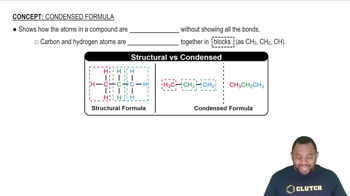
A condensed structural formula provides a simplified representation of a molecule, showing the arrangement of atoms without depicting all bonds explicitly. In the context of peptides, it highlights the sequence of amino acids and the connectivity between them, allowing for a clear visualization of the peptide's structure.


 2:41 minutes
 Verified step by step guidance
 3:07
3:07