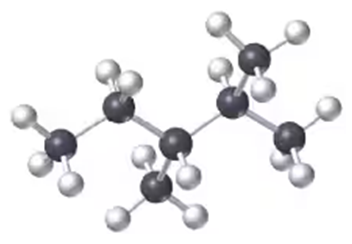
Give the IUPAC names for the following alkanes: a.
Verified step by step guidance
1
Identify the longest continuous carbon chain in the structure. This chain determines the base name of the alkane (e.g., methane, ethane, propane, etc.).
Number the carbon atoms in the longest chain starting from the end nearest to the first substituent group. This ensures the substituents have the lowest possible numbers.
Identify and name all substituent groups attached to the main chain. Substituents are alkyl groups (e.g., methyl, ethyl, propyl) or other functional groups.
Combine the names of the substituents with the base name of the alkane. Use prefixes (di-, tri-, tetra-, etc.) if there are multiple identical substituents, and list substituents in alphabetical order.
Write the final IUPAC name by placing the substituent names (with their position numbers) before the base name of the alkane, separated by hyphens. Ensure proper punctuation and formatting.
Verified video answer for a similar problem:
This video solution was recommended by our tutors as helpful for the problem above
Play a video:
Was this helpful?
Key Concepts
Here are the essential concepts you must grasp in order to answer the question correctly.
IUPAC Nomenclature
IUPAC nomenclature is a systematic method for naming chemical compounds, particularly organic molecules. It provides a set of rules to derive names based on the structure of the compound, ensuring that each name is unique and informative. For alkanes, the names are derived from the longest continuous carbon chain, with suffixes indicating the type of compound.
Alkanes are a class of hydrocarbons characterized by single bonds between carbon atoms and the general formula CnH2n+2. They are saturated compounds, meaning they contain the maximum number of hydrogen atoms per carbon atom. Alkanes are typically non-polar and exhibit low reactivity, making them important in various chemical processes and applications.
Identifying the longest carbon chain is crucial in naming alkanes according to IUPAC rules. The longest chain serves as the backbone of the molecule, and its length determines the base name of the alkane (e.g., methane, ethane, propane). Branches or substituents are then named and numbered based on their position relative to the longest chain, ensuring clarity in the compound's structure.