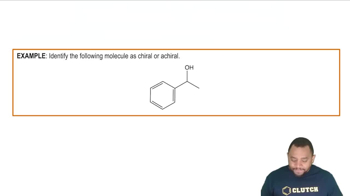
2-Aminopropane is an achiral molecule, but 2-aminobutane is chiral. Explain.
Verified step by step guidance
1
Identify the concept of chirality: A molecule is chiral if it has a carbon atom bonded to four different groups, making it non-superimposable on its mirror image. If a molecule lacks this property, it is achiral.
Analyze the structure of 2-aminopropane: The central carbon atom in 2-aminopropane is bonded to a methyl group (-CH3), an amino group (-NH2), a hydrogen atom (-H), and another methyl group (-CH3). Since two of the groups are identical (both are methyl groups), the central carbon does not have four different groups, making the molecule achiral.
Analyze the structure of 2-aminobutane: The central carbon atom in 2-aminobutane is bonded to a methyl group (-CH3), an amino group (-NH2), a hydrogen atom (-H), and an ethyl group (-CH2CH3). Since all four groups are different, the central carbon is a chiral center, making the molecule chiral.
Compare the two molecules: The key difference lies in the groups attached to the central carbon. In 2-aminopropane, the presence of two identical methyl groups prevents chirality, while in 2-aminobutane, the presence of four distinct groups creates a chiral center.
Conclude: 2-Aminopropane is achiral because it lacks a chiral center, while 2-aminobutane is chiral due to the presence of a carbon atom bonded to four different groups.
Verified video answer for a similar problem:
This video solution was recommended by our tutors as helpful for the problem above
Play a video:
Was this helpful?
Key Concepts
Here are the essential concepts you must grasp in order to answer the question correctly.
Chirality
Chirality refers to the geometric property of a molecule that makes it non-superimposable on its mirror image. A chiral molecule typically has a carbon atom bonded to four different substituents, resulting in two distinct forms known as enantiomers. In contrast, achiral molecules can be superimposed on their mirror images, indicating a lack of this asymmetry.
A stereocenter, often a chiral center, is a specific atom in a molecule, usually carbon, that has four different groups attached to it. The presence of a stereocenter is a key factor in determining whether a molecule is chiral. In the case of 2-aminobutane, the presence of a stereocenter makes it chiral, while 2-aminopropane lacks such a center, rendering it achiral.
Molecular Structure
The molecular structure of a compound refers to the arrangement of atoms within the molecule and the bonds that connect them. This arrangement influences the molecule's properties, including its chirality. For example, 2-aminopropane has a symmetrical structure that does not allow for chirality, while 2-aminobutane's structure introduces asymmetry, leading to its chiral nature.