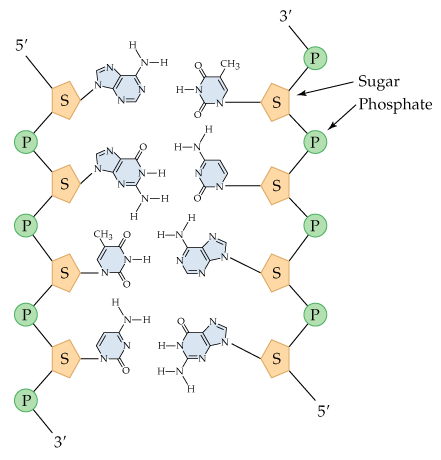
Copy the diagram and use dotted lines to indicate where hydrogen bonding occurs between the complementary strands of DNA. What is the sequence of each strand of DNA drawn (remember that the sequence is written from the 5′ to 3′ end)?
Verified step by step guidance
1
Identify the complementary base pairs in DNA: Adenine (A) pairs with Thymine (T) via two hydrogen bonds, and Cytosine (C) pairs with Guanine (G) via three hydrogen bonds.
Examine the provided DNA diagram and locate the nitrogenous bases on each strand. Ensure you understand the orientation of the strands (5′ to 3′ direction).
Draw dotted lines between the complementary bases to represent hydrogen bonds: two dotted lines between A and T, and three dotted lines between C and G.
Determine the sequence of the complementary strand by reading the bases on the opposite strand in the 5′ to 3′ direction. Remember that the strands are antiparallel, so the complementary strand runs in the opposite direction (3′ to 5′).
Write the sequence of each strand explicitly, ensuring the correct 5′ to 3′ orientation for both strands. Double-check that the base pairing and orientation are consistent with the rules of DNA structure.
Verified video answer for a similar problem:
This video solution was recommended by our tutors as helpful for the problem above
Video duration:
8m
Play a video:
Was this helpful?
Key Concepts
Here are the essential concepts you must grasp in order to answer the question correctly.
Hydrogen Bonding in DNA
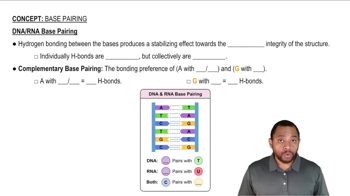
Hydrogen bonding is a type of weak chemical bond that occurs between the nitrogenous bases of DNA strands. In DNA, adenine (A) pairs with thymine (T) through two hydrogen bonds, while cytosine (C) pairs with guanine (G) through three hydrogen bonds. This specific pairing is crucial for the stability of the DNA double helix structure and ensures accurate replication and transcription.
DNA strands have a directionality defined by their sugar-phosphate backbone, which has a 5' (five-prime) end and a 3' (three-prime) end. The 5' end has a phosphate group, while the 3' end has a hydroxyl group. When writing the sequence of a DNA strand, it is essential to start from the 5' end and proceed to the 3' end, as this orientation is critical for understanding replication and transcription processes.
Complementary base pairing refers to the specific pairing of nitrogenous bases in DNA, where A pairs with T and C pairs with G. This concept is fundamental to the structure of DNA, as it allows for the formation of the double helix and ensures that genetic information is accurately copied during cell division. Understanding this pairing is essential for drawing the correct sequences and indicating hydrogen bonds in a DNA diagram.