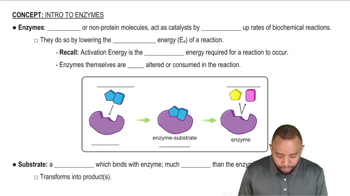
Understand that enzymes are biological catalysts that speed up chemical reactions. For DNA, enzymes are involved in processes like replication, repair, and transcription.
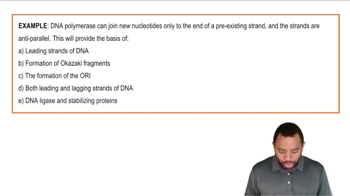
Identify the specific process involving DNA. For example, if the process is DNA replication, the enzyme involved would be DNA polymerase.
Recall that DNA polymerase is responsible for synthesizing a new strand of DNA by adding nucleotides complementary to the template strand.
If the process involves DNA repair, enzymes like DNA ligase or endonucleases may be involved. DNA ligase, for instance, seals breaks in the DNA backbone.
If the process involves transcription (the synthesis of RNA from a DNA template), the enzyme RNA polymerase is responsible for catalyzing this reaction.
Verified video answer for a similar problem:
This video solution was recommended by our tutors as helpful for the problem above
Video duration:
58s
Play a video:
Was this helpful?
Key Concepts
Here are the essential concepts you must grasp in order to answer the question correctly.
DNA Polymerase
DNA polymerase is an essential enzyme that synthesizes new DNA strands by adding nucleotides complementary to the template strand during DNA replication. It plays a critical role in ensuring the accuracy and fidelity of DNA replication, which is vital for cell division and genetic inheritance.
Restriction enzymes, also known as restriction endonucleases, are proteins that cut DNA at specific sequences. They are widely used in molecular biology for cloning, DNA analysis, and genetic engineering, allowing scientists to manipulate DNA fragments for various applications.
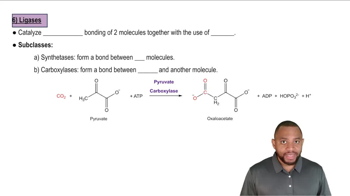
DNA ligase is an enzyme that facilitates the joining of DNA strands together by forming phosphodiester bonds. It is crucial in processes such as DNA replication and repair, as it seals nicks in the sugar-phosphate backbone, ensuring the integrity of the DNA molecule.