Identify the amino acid for which the codon GAG codes, and what other codon could encode for this same amino acid?
Verified step by step guidance
1
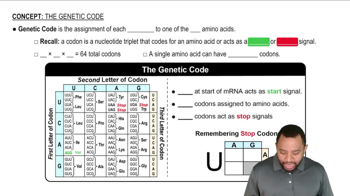
Step 1: Understand the genetic code. The genetic code is a set of rules by which nucleotide triplets (codons) in mRNA are translated into amino acids during protein synthesis. Each codon corresponds to a specific amino acid or a stop signal.
Step 2: Identify the amino acid for the codon GAG. Use a codon chart or table, which maps each codon to its corresponding amino acid. Locate GAG in the chart to determine the amino acid it codes for.
Step 3: Recognize that the genetic code is degenerate. This means that multiple codons can code for the same amino acid. For example, amino acids often have two or more codons that encode them.
Step 4: Find the other codon(s) that encode the same amino acid as GAG. Look for codons that differ by only one nucleotide but still code for the same amino acid. For GAG, check the codon chart for any synonymous codons.
Step 5: Verify your findings. Confirm that the amino acid and its synonymous codons are correctly identified by cross-referencing with a reliable codon chart or genetic code resource.
Verified video answer for a similar problem:
This video solution was recommended by our tutors as helpful for the problem above
Video duration:
51s
Play a video:
Was this helpful?
Key Concepts
Here are the essential concepts you must grasp in order to answer the question correctly.
Codons and Amino Acids
Codons are sequences of three nucleotides in mRNA that correspond to specific amino acids during protein synthesis. Each codon is part of the genetic code, which translates the information in DNA into proteins. Understanding the relationship between codons and amino acids is essential for interpreting genetic information.
The genetic code is a set of rules that defines how sequences of nucleotides in DNA and RNA are translated into proteins. It consists of 64 codons that specify 20 different amino acids, with some amino acids being encoded by multiple codons, a phenomenon known as redundancy. This redundancy allows for some mutations to occur without affecting the resulting protein.
Amino acid redundancy refers to the fact that multiple codons can code for the same amino acid. For example, the codon GAG codes for the amino acid glutamic acid, and it is also encoded by the codon GAA. This feature of the genetic code is important for understanding how mutations can impact protein synthesis and function.