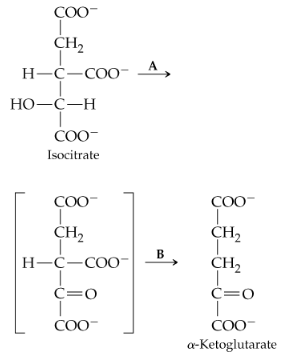
The reaction that follows is catalyzed by isocitrate dehydrogenase and occurs in two steps, the first of which (step A) is formation of an unstable intermediates (shown in brackets). d. To what class of enzymes does isocitrate dehydrogenase, the enzyme that catalyzes this reaction, belong?
Verified step by step guidance
1
Step 1: Understand the role of isocitrate dehydrogenase in the reaction. This enzyme catalyzes the oxidation of isocitrate to form an intermediate, which is then further processed in the reaction. Enzymes are classified based on the type of reaction they catalyze.
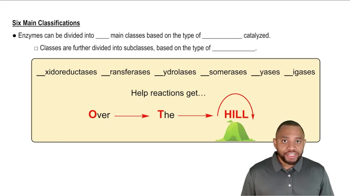
Step 2: Recall the six major classes of enzymes: oxidoreductases, transferases, hydrolases, lyases, isomerases, and ligases. Each class corresponds to a specific type of chemical reaction.
Step 3: Analyze the reaction catalyzed by isocitrate dehydrogenase. This reaction involves the removal of hydrogen atoms (oxidation) from isocitrate, which is coupled with the reduction of NAD+ (or NADP+) to NADH (or NADPH).
Step 4: Based on the reaction type, identify the enzyme class. Enzymes that catalyze oxidation-reduction reactions, where electrons are transferred, belong to the oxidoreductase class.
Step 5: Conclude that isocitrate dehydrogenase is classified as an oxidoreductase because it facilitates the oxidation of isocitrate and the reduction of NAD+ (or NADP+).
Verified video answer for a similar problem:
This video solution was recommended by our tutors as helpful for the problem above
Video duration:
1m
Play a video:
Was this helpful?
Key Concepts
Here are the essential concepts you must grasp in order to answer the question correctly.
Enzyme Classification
Enzymes are classified into six main categories based on the type of reaction they catalyze: oxidoreductases, transferases, hydrolases, lyases, isomerases, and ligases. Isocitrate dehydrogenase falls under the category of oxidoreductases, which facilitate oxidation-reduction reactions by transferring electrons between molecules.
Isocitrate dehydrogenase is an important enzyme in the citric acid cycle (Krebs cycle), where it catalyzes the conversion of isocitrate to alpha-ketoglutarate. This reaction involves the decarboxylation of isocitrate and the reduction of NAD+ to NADH, playing a crucial role in cellular respiration and energy production.
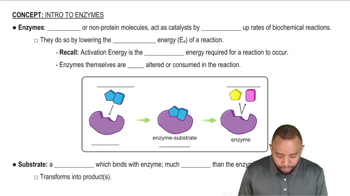
Enzyme catalysis involves the lowering of activation energy for a reaction, allowing it to proceed more quickly. In the case of isocitrate dehydrogenase, the enzyme stabilizes the transition state and facilitates the formation of unstable intermediates, which are critical for the reaction's progression and efficiency.