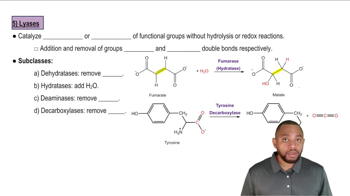
Identify and describe the chemical change in the lyase-catalyzed reaction in Table 19.4 that involves fumarate and malate. Identify the substrate(s) and product(s).
Verified step by step guidance
1
Understand the context: Lyases are enzymes that catalyze the addition or removal of groups to form double bonds or break them. In this case, the reaction involves fumarate and malate, which are intermediates in the citric acid cycle.
Identify the substrate(s): The substrate is the molecule that the enzyme acts upon. In this reaction, fumarate is the substrate because it undergoes a chemical change.
Identify the product(s): The product is the molecule formed as a result of the enzymatic reaction. In this case, malate is the product formed from fumarate.
Describe the chemical change: The lyase-catalyzed reaction involves the addition of a water molecule (H₂O) to fumarate. This reaction breaks the double bond in fumarate, converting it into malate, which contains a hydroxyl (-OH) group.
Summarize the reaction: The enzyme fumarase (a type of lyase) catalyzes the hydration of fumarate to form malate. The reaction can be represented as: .
Verified video answer for a similar problem:
This video solution was recommended by our tutors as helpful for the problem above
Video duration:
1m
Play a video:
Was this helpful?
Key Concepts
Here are the essential concepts you must grasp in order to answer the question correctly.
Lyase Enzymes
Lyases are a class of enzymes that catalyze the breaking of chemical bonds by means other than hydrolysis or oxidation. They often facilitate the addition or removal of groups to or from double bonds, resulting in the formation of new compounds. In the context of fumarate and malate, lyases play a crucial role in the conversion between these two substrates.
In biochemical reactions, substrates are the starting materials that undergo transformation, while products are the end results of the reaction. In the lyase-catalyzed reaction involving fumarate and malate, fumarate acts as the substrate that is converted into malate, which is the product. Understanding the relationship between substrates and products is essential for analyzing enzyme-catalyzed reactions.
A chemical change refers to a process where substances undergo a transformation that alters their chemical structure, resulting in the formation of new substances. In the reaction between fumarate and malate, the chemical change involves the addition of water (hydration) or the removal of a small molecule, leading to the interconversion of these two compounds. Recognizing the nature of these changes is vital for understanding metabolic pathways.