Using condensed structural formulas, or line-angle formulas if cyclic, write the balanced chemical equations for the (1) reaction of each of the following amines with water and (2) neutralization with HCl: c. aniline
Verified step by step guidance
1
Step 1: Identify the structure of aniline. Aniline is an aromatic amine with the condensed structural formula C₆H₅NH₂. It consists of a benzene ring (C₆H₅) attached to an amino group (-NH₂).
Step 2: Write the reaction of aniline with water. Amines react with water to form their conjugate acid and hydroxide ions. Represent this reaction as: C₆H₅NH₂ + H₂O → C₆H₅NH₃⁺ + OH⁻. Ensure the equation is balanced.
Step 3: Write the neutralization reaction of aniline with HCl. Amines react with acids like HCl to form their corresponding ammonium salts. Represent this reaction as: C₆H₅NH₂ + HCl → C₆H₅NH₃⁺Cl⁻. Ensure the equation is balanced.
Step 4: Confirm the physical states of the reactants and products. Aniline is typically a liquid or solid, water is a liquid, HCl is aqueous, and the products (C₆H₅NH₃⁺ and C₆H₅NH₃⁺Cl⁻) are aqueous.
Step 5: Verify the chemical equations for correctness and balance. Ensure that the number of atoms and charges are balanced on both sides of each equation.
Verified video answer for a similar problem:
This video solution was recommended by our tutors as helpful for the problem above
Video duration:
4m
Play a video:
Was this helpful?
Key Concepts
Here are the essential concepts you must grasp in order to answer the question correctly.
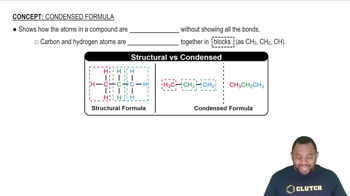
Condensed Structural Formulas
Condensed structural formulas provide a simplified representation of a molecule, showing the arrangement of atoms and the connectivity between them without depicting all the bonds explicitly. For example, aniline can be represented as C6H5NH2, indicating the presence of a phenyl group attached to an amino group. This format is essential for quickly identifying functional groups and understanding the reactivity of the compound.
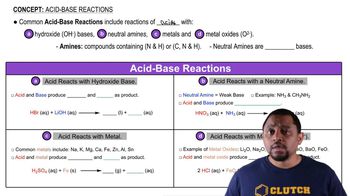
Acid-base reactions involve the transfer of protons (H+) between reactants. In the context of aniline reacting with water, it acts as a weak base, accepting a proton to form anilinium ion (C6H5NH3+). Understanding this concept is crucial for predicting the products of the reaction and balancing the chemical equation.
Neutralization reactions occur when an acid reacts with a base to produce water and a salt. In the case of aniline and hydrochloric acid (HCl), the aniline base reacts with HCl to form anilinium chloride (C6H5NH3Cl). Recognizing this type of reaction is important for writing balanced equations and understanding the resulting products.