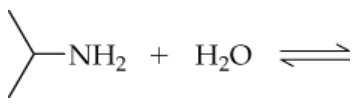
Step 1: Analyze the given chemical equation. Identify the reactants and products, and ensure that the chemical formulas are correctly written for each species.
Step 2: Apply the law of conservation of mass, which states that the number of atoms of each element must be the same on both sides of the equation. This means balancing the equation by adjusting the coefficients (the numbers in front of the chemical formulas).
Step 3: Start by balancing the elements that appear in only one reactant and one product. Leave elements like hydrogen and oxygen, which are often found in multiple compounds, for later.
Step 4: Balance hydrogen and oxygen atoms last, as they are often found in multiple compounds. Adjust the coefficients as needed to ensure the total number of each type of atom is equal on both sides of the equation.
Step 5: Double-check your work to ensure that all elements are balanced and that the coefficients are in the simplest whole-number ratio. If necessary, simplify the coefficients by dividing them by their greatest common factor.
Verified video answer for a similar problem:
This video solution was recommended by our tutors as helpful for the problem above
Play a video:
Was this helpful?
Key Concepts
Here are the essential concepts you must grasp in order to answer the question correctly.
Equations
Equations are mathematical statements that assert the equality of two expressions. They often involve variables and constants, and solving an equation means finding the values of the variables that make the equation true. Understanding how to manipulate equations, such as through addition, subtraction, multiplication, or division, is essential for completing them correctly.
Variables are symbols used to represent unknown values in mathematical expressions and equations. They can take on different values, and their manipulation is key to solving equations. Recognizing how to isolate variables and understand their relationships within an equation is crucial for finding solutions.
Mathematical operations include addition, subtraction, multiplication, and division, which are fundamental processes used to manipulate numbers and variables in equations. Mastery of these operations is necessary for simplifying expressions and solving equations effectively. Each operation has specific rules that govern how they interact with numbers and variables.