Draw the structures of the ammonium ions formed when the amines in Problem 16.30 are treated with acid. a. N-Methylpentylamine b. N-Ethylcyclobutylamine c. p-Propylaniline
Verified step by step guidance
1
Identify the amines from Problem 16.30. Amines are organic compounds that contain a nitrogen atom bonded to one or more alkyl or aryl groups. Common examples include primary (R-NH₂), secondary (R₂-NH), and tertiary (R₃-N) amines.
Understand the reaction of amines with acids. When an amine reacts with an acid, the nitrogen atom accepts a proton (H⁺) from the acid, forming an ammonium ion. This is because the nitrogen atom in the amine has a lone pair of electrons that can act as a base.
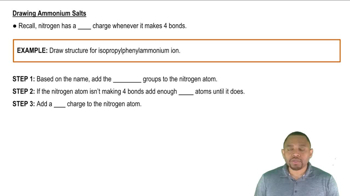
For each amine, add a proton (H⁺) to the nitrogen atom. This increases the number of hydrogen atoms bonded to the nitrogen by one and gives the nitrogen a positive charge, resulting in an ammonium ion. For example, a primary amine (R-NH₂) becomes R-NH₃⁺.
Draw the structures of the ammonium ions. Ensure that the nitrogen atom in each structure has a formal positive charge and that the correct number of hydrogen atoms is shown. For example, if the amine is CH₃-NH₂ (methylamine), the ammonium ion would be CH₃-NH₃⁺.
Verify the structures by checking that the nitrogen atom has four bonds (three to hydrogen and one to the carbon or other groups) and a formal positive charge. This ensures the structures are consistent with the chemistry of ammonium ions.
Verified video answer for a similar problem:
This video solution was recommended by our tutors as helpful for the problem above
Play a video:
Was this helpful?
Key Concepts
Here are the essential concepts you must grasp in order to answer the question correctly.
Ammonium Ion Formation
Ammonium ions (NH4+) are formed when amines react with acids. In this process, the amine, which has a lone pair of electrons, donates that pair to a proton (H+) from the acid, resulting in a positively charged ammonium ion. This reaction is crucial in understanding how amines behave in acidic environments.
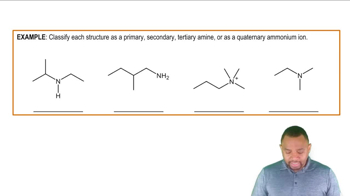
Amines are organic compounds derived from ammonia (NH3) by replacing one or more hydrogen atoms with alkyl or aryl groups. They can be classified as primary, secondary, or tertiary based on the number of carbon-containing groups attached to the nitrogen atom. Their basicity and ability to form ammonium ions are key characteristics in acid-base chemistry.
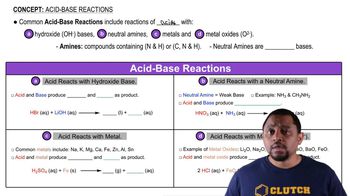
Acid-base reactions involve the transfer of protons (H+) between reactants. In the context of amines and acids, the amine acts as a base, accepting a proton to form an ammonium ion. Understanding these reactions is essential for predicting the behavior of amines in various chemical environments, particularly in organic synthesis and biological systems.