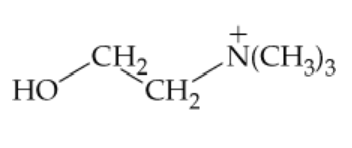
Choline has the following structure. Do you think that this substance reacts with aqueous hydrochloric acid? If so, what is the product? If not, why not?
Verified step by step guidance
1
Examine the structure of choline. Choline is an organic compound with a hydroxyl group (-OH) and a quaternary ammonium group (N⁺ with four alkyl groups attached). The quaternary ammonium group is already positively charged and does not have a lone pair of electrons to accept a proton.
Understand the nature of hydrochloric acid (HCl). HCl is a strong acid that dissociates completely in water to produce H⁺ (protons) and Cl⁻ (chloride ions). Acids typically react with bases or substances that can accept protons.
Determine if choline can react with HCl. Since the quaternary ammonium group in choline is already positively charged and cannot accept additional protons, it will not react with HCl. The hydroxyl group (-OH) in choline is not basic enough to react with HCl either.
Conclude that choline does not react with aqueous hydrochloric acid. The structure of choline does not have any functional groups that can interact with H⁺ ions from HCl.
Summarize the reasoning: Choline does not react with aqueous HCl because its quaternary ammonium group is already fully protonated and the hydroxyl group is not reactive under these conditions.
Verified video answer for a similar problem:
This video solution was recommended by our tutors as helpful for the problem above
Play a video:
Was this helpful?
Key Concepts
Here are the essential concepts you must grasp in order to answer the question correctly.
Choline Structure and Properties
Choline is a quaternary ammonium compound with a positively charged nitrogen atom and a hydroxyl group. Its structure includes a hydrocarbon chain, which influences its solubility and reactivity. Understanding its molecular structure is essential to predict how it interacts with acids and other reagents.
Acid-base reactions involve the transfer of protons (H+) between substances. In this context, hydrochloric acid (HCl) can donate protons, and choline, being a basic compound due to its nitrogen atom, can accept protons. This interaction is crucial for determining whether a reaction occurs and what products are formed.
The products of a reaction depend on the reactants' nature and the conditions under which the reaction occurs. In the case of choline and hydrochloric acid, the expected product would be a choline chloride salt, formed by the protonation of choline. Understanding how to predict reaction products is vital for analyzing chemical interactions.