Draw the following three isomers of C5H12 as condensed structures: a.
Verified step by step guidance
1
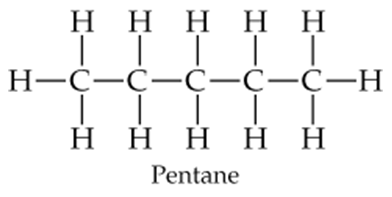
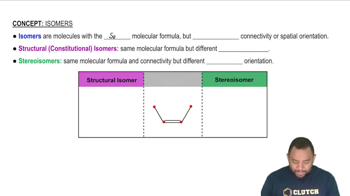
Step 1: Understand the concept of isomers. Isomers are compounds with the same molecular formula but different structural arrangements. For C₅H₁₂ (pentane), we are dealing with structural isomers, which differ in the connectivity of their atoms.
Step 2: Identify the three possible isomers of C₅H₁₂. These are: (1) n-pentane (a straight-chain structure), (2) isopentane (a branched structure with one methyl group attached to the second carbon), and (3) neopentane (a highly branched structure with a central carbon bonded to four other carbons).
Step 3: Draw the condensed structure for n-pentane. This is a straight chain of five carbon atoms, written as CH₃-CH₂-CH₂-CH₂-CH₃.
Step 4: Draw the condensed structure for isopentane. This is a branched structure where the second carbon in the chain has a methyl group attached. It can be written as CH₃-CH(CH₃)-CH₂-CH₃.
Step 5: Draw the condensed structure for neopentane. This is a highly branched structure where a central carbon is bonded to four methyl groups. It can be written as C(CH₃)₄.
Verified video answer for a similar problem:
This video solution was recommended by our tutors as helpful for the problem above
Play a video:
Was this helpful?
Key Concepts
Here are the essential concepts you must grasp in order to answer the question correctly.
Isomers
Isomers are compounds that have the same molecular formula but different structural arrangements of atoms. In the case of C₅H₁₂, there are several isomers, including straight-chain and branched forms. Understanding isomerism is crucial for recognizing how different structures can lead to different chemical properties and behaviors.
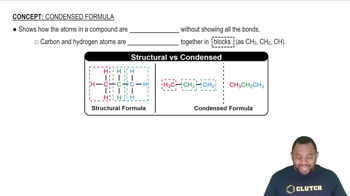
Condensed structures are a way of representing chemical compounds that shows the connectivity of atoms without depicting all the bonds explicitly. In condensed formulas, groups of atoms are often grouped together to simplify the representation. This format is particularly useful for visualizing the structure of organic molecules like the isomers of C₅H₁₂.
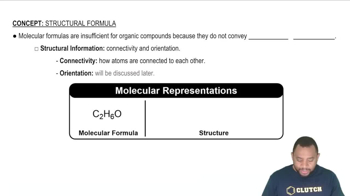
Structural representation refers to the various ways in which a chemical structure can be depicted, including Lewis structures, condensed formulas, and skeletal formulas. Each representation provides different levels of detail about the arrangement of atoms and bonds. For isomers of C₅H₁₂, accurately drawing these structures is essential for understanding their unique properties and reactivity.