Identify each of the following as a formula of an organic or inorganic compound. For an organic compound, indicate if represented as molecular formula, expanded, or condensed structural formula: e. CH3―CH2―CH2―CH2―CH3
Verified step by step guidance
1
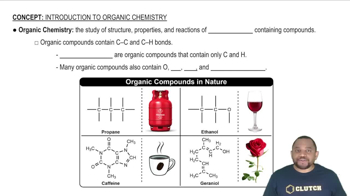
Step 1: Recognize the type of compound. Organic compounds are primarily composed of carbon (C) and hydrogen (H), and may also include oxygen (O), nitrogen (N), sulfur (S), or halogens. Inorganic compounds typically do not have carbon-hydrogen bonds.
Step 2: Analyze the given formula. The formula provided, CH₃―CH₂―CH₂―CH₂―CH₃, consists entirely of carbon (C) and hydrogen (H) atoms, indicating it is an organic compound.
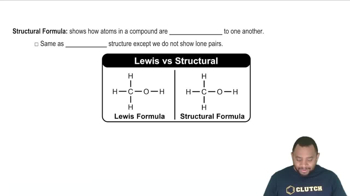
Step 3: Determine the type of formula representation. Organic compounds can be represented in different ways: molecular formula (e.g., C₅H₁₂), expanded structural formula (showing all bonds explicitly), or condensed structural formula (grouping atoms to simplify the structure).
Step 4: Identify the specific representation. The given formula explicitly shows each carbon atom and its attached hydrogen atoms, as well as the bonds between the carbon atoms. This is an expanded structural formula.
Step 5: Conclude the classification. The compound is an organic compound, and the formula is represented as an expanded structural formula.
Verified video answer for a similar problem:
This video solution was recommended by our tutors as helpful for the problem above
Play a video:
Was this helpful?
Key Concepts
Here are the essential concepts you must grasp in order to answer the question correctly.
Organic Compounds
Organic compounds are primarily composed of carbon atoms, often in combination with hydrogen, oxygen, nitrogen, and other elements. They are characterized by the presence of carbon-hydrogen (C-H) bonds. Common examples include hydrocarbons, alcohols, and acids. Understanding the structure and bonding in organic compounds is essential for identifying their properties and reactions.
Structural formulas represent the arrangement of atoms within a molecule, showing how atoms are connected. There are different types of structural formulas: molecular formulas indicate the number of each type of atom, expanded structural formulas depict all bonds explicitly, and condensed structural formulas provide a simplified view. Recognizing these formats is crucial for interpreting chemical structures accurately.
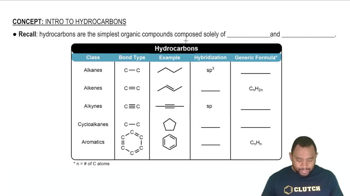
Hydrocarbons are organic compounds consisting solely of hydrogen and carbon. They can be classified into aliphatic (straight or branched chains) and aromatic (ring structures). The example given, CH₃―CH₂―CH₂―CH₂―CH₃, is a straight-chain alkane, specifically pentane. Understanding hydrocarbons is fundamental in organic chemistry, as they serve as the backbone for more complex organic molecules.