There are four amine isomers with the molecular formula C3H9N. Draw their condensed structural formulas, write the common name, and classify each as a primary (1°), secondary (2°), or tertiary (3°) amine.
Verified step by step guidance
1
Step 1: Understand the molecular formula C₃H₉N. This indicates that the molecule contains three carbon atoms, nine hydrogen atoms, and one nitrogen atom. Amines are organic compounds derived from ammonia (NH₃) where one or more hydrogen atoms are replaced by alkyl or aryl groups.
Step 2: Begin by constructing the possible isomers. Start with the primary amine (1°), where the nitrogen atom is bonded to one alkyl group and two hydrogen atoms. Draw the condensed structural formula for CH₃CH₂CH₂NH₂ (propylamine).
Step 3: Next, consider another primary amine isomer. Rearrange the carbon chain to form an isomer with a branched structure. Draw the condensed structural formula for (CH₃)₂CHNH₂ (isopropylamine).
Step 4: Move on to the secondary amine (2°), where the nitrogen atom is bonded to two alkyl groups and one hydrogen atom. Draw the condensed structural formula for CH₃CH₂NHCH₃ (ethylmethylamine).
Step 5: Finally, construct the tertiary amine (3°), where the nitrogen atom is bonded to three alkyl groups and no hydrogen atoms. Draw the condensed structural formula for (CH₃)₃N (trimethylamine). Classify each isomer as primary, secondary, or tertiary based on the number of alkyl groups attached to the nitrogen atom.
Verified video answer for a similar problem:
This video solution was recommended by our tutors as helpful for the problem above
Video duration:
1m
Play a video:
Was this helpful?
Key Concepts
Here are the essential concepts you must grasp in order to answer the question correctly.
Amine Classification
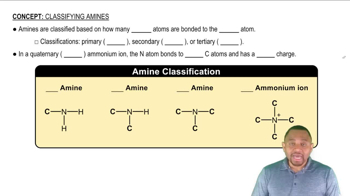
Amines are classified based on the number of carbon atoms bonded to the nitrogen atom. Primary (1°) amines have one carbon atom attached to the nitrogen, secondary (2°) amines have two, and tertiary (3°) amines have three. This classification is crucial for understanding the reactivity and properties of different amines.
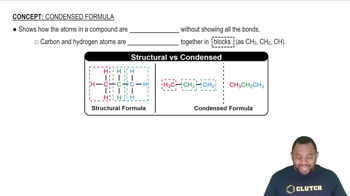
A condensed structural formula provides a simplified representation of a molecule, showing the arrangement of atoms without depicting all the bonds explicitly. For amines, this format helps in visualizing the connectivity of carbon and nitrogen atoms, which is essential for identifying isomers and their classifications.
Isomerism refers to the existence of compounds with the same molecular formula but different structural arrangements. In the case of C₃H₉N, the four amine isomers differ in how the nitrogen atom is connected to the carbon skeleton, leading to variations in their chemical and physical properties, which must be recognized when drawing their structures.