Draw the condensed structural or line-angle formula if cyclic, for each of the following: d. N-propylaniline
Verified step by step guidance
1
Step 1: Understand the structure of aniline. Aniline is a benzene ring (a six-membered aromatic ring with alternating double bonds) with an amino group (-NH₂) attached to one of the carbons.
Step 2: Recognize the 'N-propyl' group. This indicates that a propyl group (a three-carbon chain, CH₃-CH₂-CH₂-) is attached to the nitrogen atom of the amino group in aniline.
Step 3: Combine the structures. Attach the propyl group to the nitrogen atom of the amino group in aniline. The nitrogen will now have one hydrogen atom and one propyl group bonded to it.
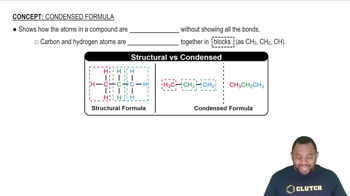
Step 4: Draw the condensed structural formula. Represent the benzene ring as C₆H₅, the amino group as -NH, and the propyl group as -CH₂CH₂CH₃. Combine these to form the condensed structural formula: C₆H₅-NH-CH₂CH₂CH₃.
Step 5: If a line-angle formula is required, draw a hexagon to represent the benzene ring, with a line extending from one vertex to represent the amino group. From the nitrogen atom, draw a three-carbon chain to represent the propyl group.
Verified video answer for a similar problem:
This video solution was recommended by our tutors as helpful for the problem above
Video duration:
2m
Play a video:
Was this helpful?
Key Concepts
Here are the essential concepts you must grasp in order to answer the question correctly.
Condensed Structural Formula
A condensed structural formula is a way of representing a chemical compound that shows the arrangement of atoms and the connectivity between them without depicting all the bonds explicitly. It typically groups atoms together to indicate how they are connected, making it easier to visualize the structure of organic molecules, especially in larger compounds.
The line-angle formula, also known as the skeletal formula, is a shorthand representation of organic molecules where vertices represent carbon atoms and lines represent bonds. This method simplifies the drawing of complex structures by omitting hydrogen atoms attached to carbons, allowing chemists to focus on the overall shape and connectivity of the molecule.
Cyclic compounds are organic molecules that contain a ring structure, where the carbon atoms are connected in a loop. This configuration can significantly influence the chemical properties and reactivity of the compound. Understanding cyclic structures is essential for accurately drawing their condensed or line-angle formulas, as the ring affects how substituents are positioned.