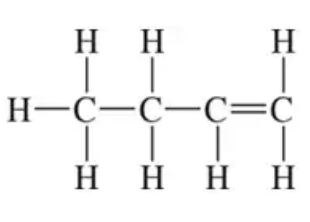
Draw a skeletal structure for each of the following compounds: (b)
Verified step by step guidance
1
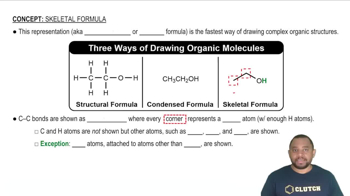
Step 1: Understand the concept of a skeletal structure. A skeletal structure (or line-angle formula) is a simplified organic chemistry representation where carbon atoms are represented by vertices (corners) or line ends, and hydrogen atoms bonded to carbons are implied but not shown explicitly. Non-carbon atoms (heteroatoms) and their attached hydrogens are explicitly shown.
Step 2: Analyze the given compound. Since the problem references an image, identify the functional groups, the number of carbon atoms, and any heteroatoms (e.g., oxygen, nitrogen, etc.) in the compound. This will help you determine the structure.
Step 3: Begin drawing the skeletal structure. Start by placing the carbon backbone as a series of connected lines. Each vertex or line end represents a carbon atom. Ensure the correct number of carbons is represented based on the compound's formula.
Step 4: Add any functional groups or heteroatoms to the structure. For example, if the compound contains an -OH group, place it on the appropriate carbon. Double or triple bonds should also be represented as double or triple lines between carbons.
Step 5: Verify the structure. Check that each carbon has four bonds (including implied hydrogens) and that the placement of functional groups and heteroatoms matches the compound's description. Adjust as necessary to ensure accuracy.
Verified video answer for a similar problem:
This video solution was recommended by our tutors as helpful for the problem above
Video duration:
1m
Play a video:
Was this helpful?
Key Concepts
Here are the essential concepts you must grasp in order to answer the question correctly.
Skeletal Structures
Skeletal structures are simplified representations of organic molecules that depict the arrangement of atoms without showing all the hydrogen atoms explicitly. In these diagrams, carbon atoms are represented by vertices or ends of lines, while bonds between them are shown as lines. This method allows chemists to visualize complex molecules more easily and focus on functional groups and connectivity.
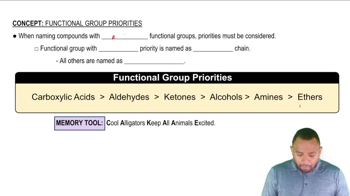
Functional groups are specific groups of atoms within molecules that are responsible for the characteristic chemical reactions of those molecules. They determine the properties and reactivity of organic compounds. Common functional groups include hydroxyl (-OH), carboxyl (-COOH), and amino (-NH2), and recognizing them is crucial for understanding the behavior of organic compounds in chemical reactions.
Bonding and hybridization refer to the ways in which atoms combine to form molecules. Hybridization is the concept of mixing atomic orbitals to create new hybrid orbitals that can form sigma and pi bonds. Understanding the types of bonds (single, double, triple) and the hybridization states (sp, sp2, sp3) of carbon is essential for accurately drawing skeletal structures and predicting molecular geometry.