What is the difference between a conformational isomer of a compound and a structural isomer of the same compound?
Verified step by step guidance
1
Conformational isomers (or conformers) are different spatial arrangements of the same molecule that can be interconverted by rotation around single bonds. These isomers do not involve breaking or forming chemical bonds.
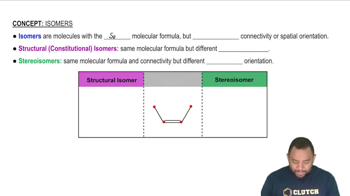
Structural isomers (or constitutional isomers) are compounds with the same molecular formula but different connectivity of atoms. This means the atoms are bonded in a different order, resulting in distinct compounds.
To identify conformational isomers, examine the molecule's ability to rotate around single bonds and observe the different spatial arrangements that result without altering the connectivity of atoms.
To identify structural isomers, compare the connectivity of atoms in the molecules. If the atoms are connected differently, they are structural isomers, even if they share the same molecular formula.
In summary, conformational isomers differ in spatial arrangement due to bond rotation, while structural isomers differ in the actual connectivity of atoms within the molecule.
Verified video answer for a similar problem:
This video solution was recommended by our tutors as helpful for the problem above
Video duration:
2m
Play a video:
Was this helpful?
Key Concepts
Here are the essential concepts you must grasp in order to answer the question correctly.
Conformational Isomers
Conformational isomers, also known as rotamers, are different spatial arrangements of the same molecule that result from the rotation around single bonds. These isomers can interconvert easily at room temperature and do not involve breaking any bonds. An example is the staggered and eclipsed forms of ethane, which differ in their dihedral angles but have the same molecular formula.
Structural isomers are compounds that have the same molecular formula but differ in the connectivity of their atoms. This means that the atoms are bonded together in different ways, leading to distinct compounds with different properties. For instance, butane and isobutane are structural isomers, as they have the same formula (C4H10) but different arrangements of carbon atoms.
Isomerism is a phenomenon where two or more compounds share the same molecular formula but differ in structure or spatial arrangement. It is broadly categorized into structural isomerism and stereoisomerism, with conformational and structural isomers being specific types. Understanding isomerism is crucial in chemistry as it influences the physical and chemical properties of compounds, impacting their reactivity and behavior in biological systems.