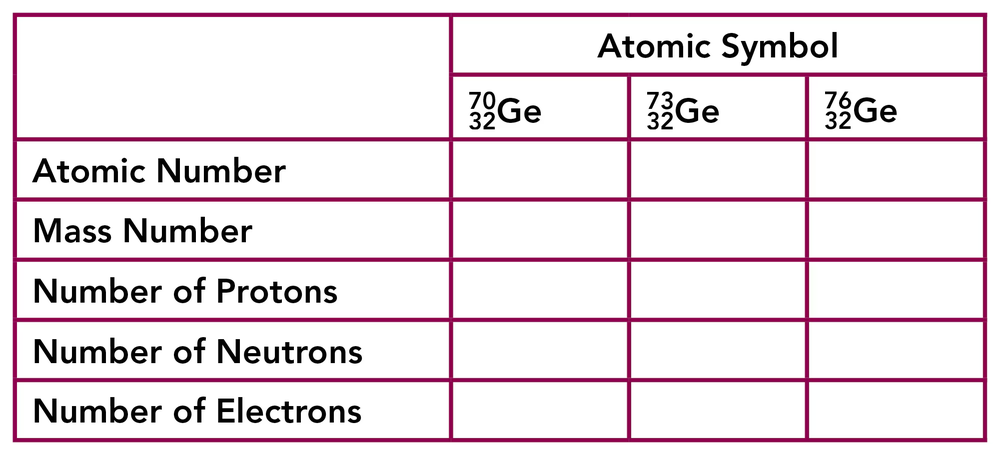
Complete the following table for three of the naturally occurring isotopes of germanium, which is a metalloid used in semiconductor.
Verified step by step guidance
1
Step 1: Identify the atomic number of germanium (Ge) from the periodic table. The atomic number is 32, which represents the number of protons in the nucleus of the atom.
Step 2: For each isotope, note the mass number provided in the table (70, 73, and 76). The mass number is the sum of protons and neutrons in the nucleus.
Step 3: Calculate the number of neutrons for each isotope using the formula: \( \text{Number of Neutrons} = \text{Mass Number} - \text{Atomic Number} \). For example, for \( ^{70}_{32} \text{Ge} \), \( \text{Number of Neutrons} = 70 - 32 \). Repeat for \( ^{73}_{32} \text{Ge} \) and \( ^{76}_{32} \text{Ge} \).
Step 4: Determine the number of electrons for each isotope. Since germanium is neutral in its elemental form, the number of electrons equals the atomic number (32).
Step 5: Fill in the table with the calculated values for atomic number, mass number, number of protons, number of neutrons, and number of electrons for each isotope.
Verified video answer for a similar problem:
This video solution was recommended by our tutors as helpful for the problem above
Video duration:
2m
Play a video:
Was this helpful?
Key Concepts
Here are the essential concepts you must grasp in order to answer the question correctly.
Isotopes
Isotopes are variants of a chemical element that have the same number of protons but different numbers of neutrons. This results in different mass numbers for the isotopes. For example, germanium has several isotopes, including 70Ge, 73Ge, and 76Ge, each differing in their neutron count while maintaining the same atomic number of 32.
The atomic number of an element is the number of protons in its nucleus, which determines the element's identity. The mass number is the total number of protons and neutrons in the nucleus. For germanium isotopes, the atomic number is always 32, while the mass number varies among the isotopes, reflecting their different neutron counts.
Subatomic particles include protons, neutrons, and electrons, which make up atoms. Protons are positively charged and found in the nucleus, neutrons are neutral and also located in the nucleus, while electrons are negatively charged and orbit the nucleus. The number of protons defines the element, while the number of neutrons affects the isotope and its stability.