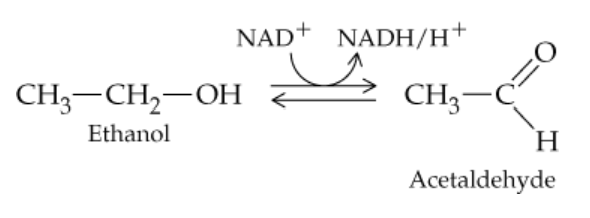
Alcohol dehydrogenase (ADH) catalyzes the following reaction. To what class of enzymes does ADH belong?
Verified step by step guidance
1
Identify the reaction catalyzed by alcohol dehydrogenase (ADH). The reaction involves the oxidation of an alcohol to an aldehyde or ketone, typically with the reduction of NAD⁺ to NADH.
Recall the six major classes of enzymes: oxidoreductases, transferases, hydrolases, lyases, isomerases, and ligases. Each class is defined by the type of reaction it catalyzes.
Determine the type of reaction occurring in this case. Since ADH facilitates the transfer of electrons (oxidation of alcohol and reduction of NAD⁺), it falls under the category of redox reactions.
Match the reaction type to the appropriate enzyme class. Enzymes that catalyze redox reactions are classified as oxidoreductases.
Conclude that alcohol dehydrogenase (ADH) belongs to the oxidoreductase class of enzymes, as it catalyzes the oxidation of alcohols and the reduction of NAD⁺.
Verified video answer for a similar problem:
This video solution was recommended by our tutors as helpful for the problem above
Video duration:
1m
Play a video:
Was this helpful?
Key Concepts
Here are the essential concepts you must grasp in order to answer the question correctly.
Enzymes
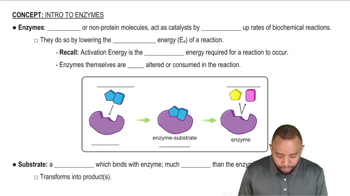
Enzymes are biological catalysts that accelerate chemical reactions in living organisms. They are typically proteins that lower the activation energy required for reactions, thus increasing the rate at which they occur. Enzymes are highly specific, meaning each type catalyzes a particular reaction or set of reactions.
Oxidoreductases are a class of enzymes that facilitate oxidation-reduction reactions, where the transfer of electrons occurs between molecules. These enzymes play a crucial role in metabolic processes, including the breakdown of alcohols and sugars. Alcohol dehydrogenase (ADH) specifically catalyzes the oxidation of alcohols to aldehydes or ketones, making it a member of this class.
Substrate specificity refers to the ability of an enzyme to selectively catalyze a reaction for a particular substrate or group of substrates. This specificity is determined by the enzyme's active site, which has a unique shape and chemical environment that fits only certain molecules. In the case of ADH, it specifically acts on alcohol substrates, converting them into their corresponding aldehydes.