Dichloroethylene 1C2H2Cl22 has three forms (isomers), each
of which is a different substance. (c) How many isomeric forms can chloroethylene, C2H3Cl,
have? Would they be expected to have dipole moments?
Verified step by step guidance
1
insert step 1> Identify the molecular formula of chloroethylene, which is C_2H_3Cl.
insert step 2> Recognize that isomers are compounds with the same molecular formula but different structural arrangements.
insert step 3> Consider the possible structural arrangements for C_2H_3Cl, focusing on the position of the chlorine atom relative to the double bond in the ethylene (C=C) group.
insert step 4> Determine the possible isomers: 1-chloroethylene (vinyl chloride) and 2-chloroethylene.
insert step 5> Evaluate the symmetry of each isomer to determine if they have a dipole moment. Asymmetrical molecules typically have a dipole moment, while symmetrical ones do not.
Verified video answer for a similar problem:
This video solution was recommended by our tutors as helpful for the problem above.
Video duration:
7m
Play a video:
0 Comments
Key Concepts
Here are the essential concepts you must grasp in order to answer the question correctly.
Isomerism
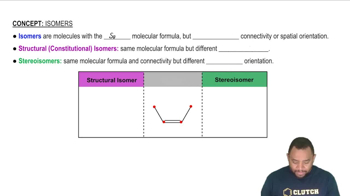
Isomerism refers to the phenomenon where two or more compounds have the same molecular formula but different structural arrangements or spatial orientations of atoms. In organic chemistry, isomers can be classified into structural isomers, which differ in the connectivity of atoms, and stereoisomers, which have the same connectivity but differ in the arrangement of atoms in space. Understanding isomerism is crucial for predicting the properties and reactivity of compounds.
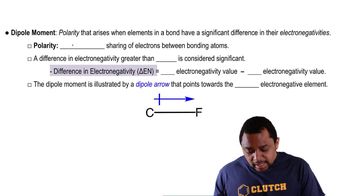
A dipole moment is a measure of the separation of positive and negative charges in a molecule, indicating the polarity of the molecule. It arises when there is an uneven distribution of electron density, often due to differences in electronegativity between atoms. Molecules with significant dipole moments are polar and can interact with other polar substances, affecting their physical properties such as solubility and boiling points.
Chloroethylene (C2H3Cl) can exist in multiple isomeric forms due to the presence of different arrangements of chlorine and hydrogen atoms around the carbon skeleton. The two primary isomers are vinyl chloride (with the chlorine atom attached to a carbon in a double bond) and 1,1-dichloroethylene (where both chlorine atoms are attached to the same carbon). The presence of these isomers can influence their dipole moments, with some isomers being polar and others nonpolar.

 7:06 minutes
 Verified step by step guidance
 2:14
2:14