
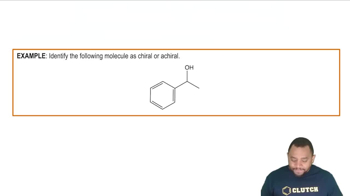
Identify all chiral centers in the isomers that you drew for part (a).
Verified step by step guidance
1
Step 1: Recall the definition of a chiral center. A chiral center (or stereocenter) is a carbon atom that is bonded to four different groups or atoms. This asymmetry makes the molecule non-superimposable on its mirror image.
Step 2: Examine the molecular structure of each isomer you drew in part (a). Look at each carbon atom and determine if it is bonded to four distinct groups or atoms.
Step 3: For each carbon atom, verify the groups attached. If any two groups are identical, the carbon is not a chiral center. Ensure that all four groups are unique for a carbon to qualify as a chiral center.
Step 4: Mark or highlight the chiral centers in each isomer. This can be done by circling the chiral carbons or labeling them with an asterisk (*) for clarity.
Step 5: Double-check your work to ensure no chiral centers were missed. Confirm that each identified chiral center meets the criteria of being bonded to four different groups or atoms.
Verified video answer for a similar problem:
This video solution was recommended by our tutors as helpful for the problem above
Play a video:
Was this helpful?
Key Concepts
Here are the essential concepts you must grasp in order to answer the question correctly.
Chirality
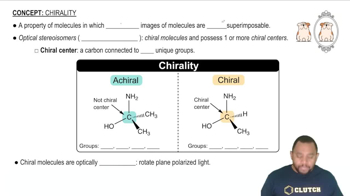
Chirality refers to the geometric property of a molecule that makes it non-superimposable on its mirror image. A chiral molecule typically has at least one carbon atom bonded to four different substituents, creating two distinct forms known as enantiomers. Understanding chirality is essential for identifying chiral centers in molecular structures.
A chiral center, often a carbon atom, is a point in a molecule where the interchange of two groups leads to a different configuration. Identifying chiral centers is crucial in stereochemistry, as these centers determine the optical activity of the molecule. Each chiral center contributes to the overall chirality of the molecule, influencing its chemical behavior and interactions.
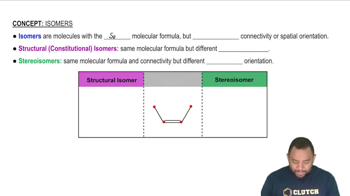
Isomers are compounds that share the same molecular formula but differ in the arrangement of atoms or the spatial orientation of their components. There are various types of isomers, including structural isomers and stereoisomers, the latter of which includes enantiomers that arise from chiral centers. Recognizing the different isomers is vital for analyzing their properties and behaviors in chemical reactions.