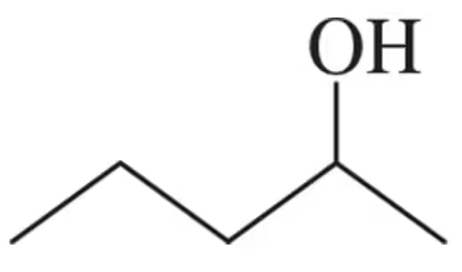
Mark the chiral centers in the following molecules, if any, with an asterisk (*): (a)
Verified step by step guidance
1
Identify the definition of a chiral center: A chiral center is a carbon atom that is bonded to four different groups or atoms. This asymmetry makes the carbon atom chiral.
Examine the structure of the molecule provided in the image. Focus on each carbon atom individually to determine if it is bonded to four distinct groups or atoms.
For each carbon atom, check the groups or atoms attached to it. If all four groups are different, mark that carbon as a chiral center with an asterisk (*).
If a carbon atom is bonded to two or more identical groups, it cannot be a chiral center. Skip marking such carbons.
Repeat this process for all carbon atoms in the molecule to ensure no chiral centers are missed. Mark all identified chiral centers with an asterisk (*).
Verified video answer for a similar problem:
This video solution was recommended by our tutors as helpful for the problem above
Video duration:
3m
Play a video:
Was this helpful?
Key Concepts
Here are the essential concepts you must grasp in order to answer the question correctly.
Chirality
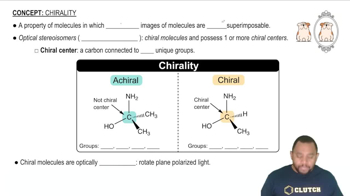
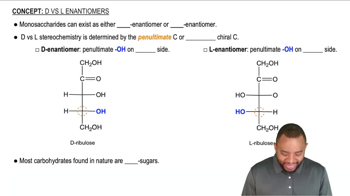
Chirality refers to the geometric property of a molecule that makes it non-superimposable on its mirror image. A chiral molecule typically has at least one carbon atom bonded to four different substituents, creating two distinct forms known as enantiomers. Understanding chirality is essential for identifying chiral centers in organic compounds.
A chiral center, often a carbon atom, is a point in a molecule where the interchange of two groups leads to a different configuration. Identifying chiral centers is crucial for determining the optical activity of a compound, as these centers are responsible for the molecule's ability to rotate plane-polarized light. In the context of the question, marking these centers is necessary for proper stereochemical representation.
Stereochemistry is the study of the spatial arrangement of atoms in molecules and how this arrangement affects their chemical properties and reactions. It encompasses concepts like chirality and enantiomers, which are vital for understanding how different molecular configurations can lead to different biological activities. In the given question, a solid grasp of stereochemistry is needed to accurately identify and mark chiral centers.