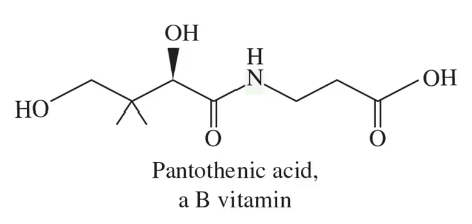
Mark the chiral centers in the following molecules, if any, with an asterisk (*): (b)
Verified step by step guidance
1
Identify the definition of a chiral center: A chiral center is a carbon atom that is bonded to four different groups or atoms. This property makes the molecule non-superimposable on its mirror image.
Examine the structure of Pantothenic Acid (provided in the image) and locate all carbon atoms in the molecule.
For each carbon atom, check the groups or atoms attached to it. If a carbon atom is bonded to four different groups, mark it as a chiral center with an asterisk (*).
Pay special attention to carbon atoms in the molecule that are part of functional groups or branching chains, as these are more likely to be chiral centers.
Once all chiral centers are identified, ensure that no symmetry or identical groups invalidate the chirality of the marked carbons.
Verified video answer for a similar problem:
This video solution was recommended by our tutors as helpful for the problem above
Video duration:
3m
Play a video:
Was this helpful?
Key Concepts
Here are the essential concepts you must grasp in order to answer the question correctly.
Chirality
Chirality refers to the geometric property of a molecule that makes it non-superimposable on its mirror image. Molecules that possess chirality have at least one chiral center, typically a carbon atom bonded to four different substituents. This property is crucial in biochemistry, as chiral molecules can have different biological activities depending on their orientation.
A chiral center, often a carbon atom, is a point in a molecule where the arrangement of atoms or groups leads to chirality. Identifying chiral centers is essential for understanding the stereochemistry of a compound, as these centers determine the molecule's optical activity and its interaction with biological systems. In practice, marking chiral centers with an asterisk (*) helps in visualizing and analyzing molecular structures.
Stereochemistry is the branch of chemistry that deals with the spatial arrangement of atoms in molecules and the impact of this arrangement on their chemical properties and reactions. It encompasses concepts such as chirality, isomerism, and conformational analysis. Understanding stereochemistry is vital for fields like drug design, where the efficacy of a compound can depend on its three-dimensional structure.