Mark the chiral centers in the following molecules, if any, with an asterisk (*). (d)
Verified step by step guidance
1
Identify the structure of dihydroxyacetone. Dihydroxyacetone is a simple carbohydrate with the molecular formula C3H6O3. Its structure consists of a three-carbon chain with two hydroxyl (-OH) groups and one carbonyl (C=O) group.
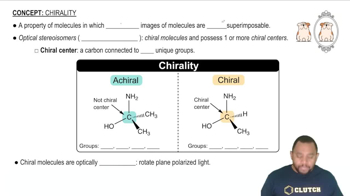
Recall the definition of a chiral center. A chiral center is a carbon atom that is bonded to four different groups or atoms. This asymmetry makes the carbon atom chiral.
Examine each carbon atom in the dihydroxyacetone molecule. Start with the first carbon, then the second, and finally the third. Check if each carbon is bonded to four distinct groups.
Analyze the central carbon atom (C2) in dihydroxyacetone. This carbon is part of the carbonyl group (C=O) and is bonded to two other carbons. Since it does not have four distinct groups, it is not a chiral center.
Conclude that dihydroxyacetone does not have any chiral centers. None of the carbon atoms in the molecule meet the criteria for chirality, as no carbon is bonded to four unique groups.
Verified video answer for a similar problem:
This video solution was recommended by our tutors as helpful for the problem above
Video duration:
2m
Play a video:
Was this helpful?
Key Concepts
Here are the essential concepts you must grasp in order to answer the question correctly.
Chirality
Chirality refers to the geometric property of a molecule that makes it non-superimposable on its mirror image. A chiral molecule typically has at least one carbon atom bonded to four different substituents, creating two distinct forms known as enantiomers. Understanding chirality is crucial in fields like pharmacology, as different enantiomers can have different biological effects.
A chiral center, often a carbon atom, is a point in a molecule where the interchange of two groups produces a stereoisomer. Identifying chiral centers is essential for determining the stereochemistry of a compound. In the context of the question, marking these centers helps in understanding the molecule's potential interactions and reactivity.
Dihydroxyacetone (DHA) is a simple carbohydrate and the active ingredient in many self-tanning products. It is a three-carbon molecule with two hydroxyl groups, but it does not have any chiral centers, as it does not possess a carbon atom bonded to four different groups. Recognizing the structure and properties of DHA is important for understanding its application in cosmetic chemistry.


 2:59 minutes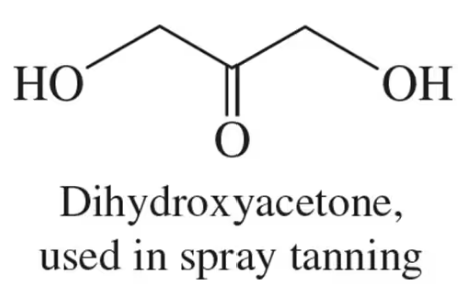
 Verified step by step guidance
 1:39
1:39