Give IUPAC names for the five isomers with the formula C6H14.
Verified step by step guidance
1
Step 1: Understand the molecular formula C₆H₁₄. This formula represents an alkane (a saturated hydrocarbon) because it follows the general formula for alkanes, CₙH₂ₙ₊₂. The presence of six carbons indicates that the parent chain will have six or fewer carbons, depending on branching.
Step 2: Identify the possible structures for C₆H₁₄. These structures are isomers, meaning they have the same molecular formula but different arrangements of atoms. Start with the straight-chain alkane (n-hexane) and then consider branching to create other isomers.
Step 3: Name the straight-chain isomer. The unbranched structure with six carbons is called hexane. This is the simplest isomer of C₆H₁₄.
Step 4: Create and name the branched isomers. For each structure, identify the longest continuous carbon chain (the parent chain) and name it. Then, identify and name the substituents (branches) and assign their positions using the lowest possible numbers. Examples include 2-methylpentane, 3-methylpentane, 2,2-dimethylbutane, and 2,3-dimethylbutane.
Step 5: Verify that all five isomers are unique. Ensure that no two structures are identical and that all possible branching patterns have been considered. Double-check the IUPAC names to confirm they follow the naming rules correctly.
Verified video answer for a similar problem:
This video solution was recommended by our tutors as helpful for the problem above
Play a video:
Was this helpful?
Key Concepts
Here are the essential concepts you must grasp in order to answer the question correctly.
IUPAC Nomenclature
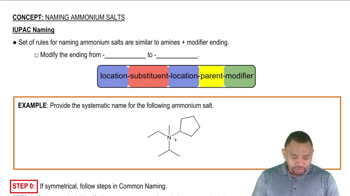
IUPAC nomenclature is a systematic method for naming chemical compounds. It provides a set of rules to ensure that each compound has a unique and descriptive name, which reflects its structure. Understanding these rules is essential for accurately naming isomers, as it helps in identifying the correct prefixes, suffixes, and numbering of carbon chains.
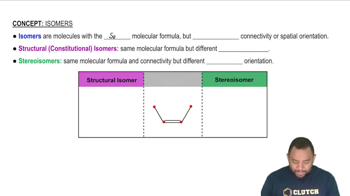
Isomers are compounds that have the same molecular formula but differ in the arrangement of atoms. This can lead to different physical and chemical properties. For C₆H₁₄, recognizing the types of isomers—structural isomers, which differ in connectivity, and stereoisomers, which differ in spatial arrangement—is crucial for identifying all possible variations.
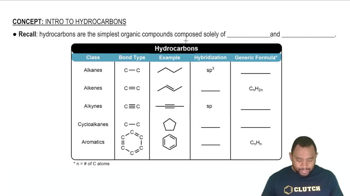
Hydrocarbons are organic compounds consisting entirely of hydrogen and carbon. The formula C₆H₁₄ indicates a saturated hydrocarbon, specifically an alkane, which contains only single bonds. Understanding the characteristics of alkanes, including their general formula (CₙH₂ₙ₊₂), helps in identifying the structural possibilities for the isomers of C₆H₁₄.