Which number in each of the following pairs is larger? a. 7.2 × 10³ or 8.2 × 10²
Verified step by step guidance
1
Step 1: Understand the problem. You are comparing two numbers written in scientific notation: 7.2 × 10³ and 8.2 × 10². The goal is to determine which number is larger.
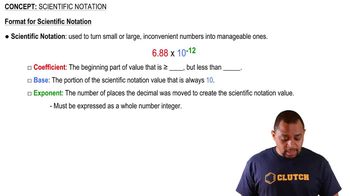
Step 2: Recall the structure of scientific notation. A number in scientific notation is written as \( a \times 10^n \), where \( a \) is the coefficient (a number between 1 and 10) and \( n \) is the exponent (an integer). The exponent determines the scale or magnitude of the number.
Step 3: Compare the exponents first. In this case, the exponents are 3 for \( 7.2 \times 10^3 \) and 2 for \( 8.2 \times 10^2 \). Since 10³ (1000) is larger than 10² (100), the number with the larger exponent will generally be larger.
Step 4: If the exponents were equal, you would compare the coefficients (7.2 and 8.2). However, since the exponents are different, the number with the larger exponent (7.2 × 10³) is automatically larger.
Step 5: Conclude that \( 7.2 \times 10^3 \) is larger than \( 8.2 \times 10^2 \) based on the comparison of their exponents.
Verified video answer for a similar problem:
This video solution was recommended by our tutors as helpful for the problem above
Video duration:
1m
Play a video:
Was this helpful?
Key Concepts
Here are the essential concepts you must grasp in order to answer the question correctly.
Scientific Notation
Scientific notation is a way of expressing numbers that are too large or too small to be conveniently written in decimal form. It is typically formatted as 'a x 10^n', where 'a' is a number greater than or equal to 1 and less than 10, and 'n' is an integer. This notation simplifies calculations and comparisons between very large or very small numbers.
Exponents indicate how many times a number, known as the base, is multiplied by itself. In scientific notation, the exponent represents the power of ten that scales the number. Understanding exponents is crucial for comparing numbers in scientific notation, as a higher exponent indicates a larger value when the base is the same.
To compare numbers in scientific notation, one must first ensure they are expressed with the same exponent. If the exponents differ, the number with the larger exponent is greater. If the exponents are the same, the coefficients (the numbers before the 'x') can be directly compared to determine which is larger.