Write each of the following in scientific notation: a. 0.000 026
Verified step by step guidance
1
Identify the significant digits in the number 0.000 026. These are the non-zero digits, which in this case are '26'.
Determine the decimal point's position in the original number. In 0.000 026, the decimal point is located after the leading zeros and before the '26'.
Rewrite the number so that it is expressed as a value between 1 and 10. To do this, move the decimal point to the right until only one non-zero digit remains to the left of the decimal point. For 0.000 026, this becomes 2.6.
Count the number of places the decimal point was moved. In this case, the decimal point was moved 5 places to the right.
Express the number in scientific notation using the format \( a \times 10^n \), where \( a \) is the rewritten number (2.6) and \( n \) is the negative of the number of places the decimal point was moved (\( -5 \)). The result is \( 2.6 \times 10^{-5} \).
Verified video answer for a similar problem:
This video solution was recommended by our tutors as helpful for the problem above
Video duration:
1m
Play a video:
Was this helpful?
Key Concepts
Here are the essential concepts you must grasp in order to answer the question correctly.
Scientific Notation
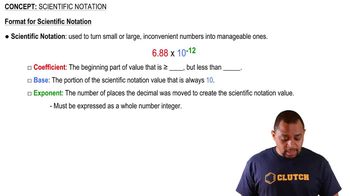
Scientific notation is a method of expressing numbers that are too large or too small in a compact form. It is written as the product of a number between 1 and 10 and a power of ten. For example, the number 0.000026 can be expressed as 2.6 x 10^-5, where 2.6 is the coefficient and -5 indicates the decimal point has moved five places to the right.
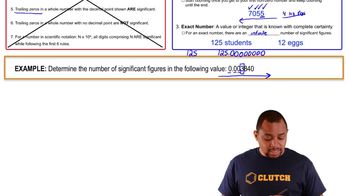
Significant figures are the digits in a number that contribute to its precision. This includes all non-zero digits, any zeros between significant digits, and trailing zeros in the decimal portion. Understanding significant figures is crucial when converting numbers to scientific notation, as it ensures that the precision of the original number is maintained in its new form.
Exponent rules govern how to manipulate powers of ten in scientific notation. Key rules include the product of powers (adding exponents when multiplying like bases) and the power of a power (multiplying exponents when raising a power to another power). These rules are essential for correctly converting numbers into scientific notation and performing calculations involving them.