Join thousands of students who trust us to help them ace their exams!
Multiple Choice
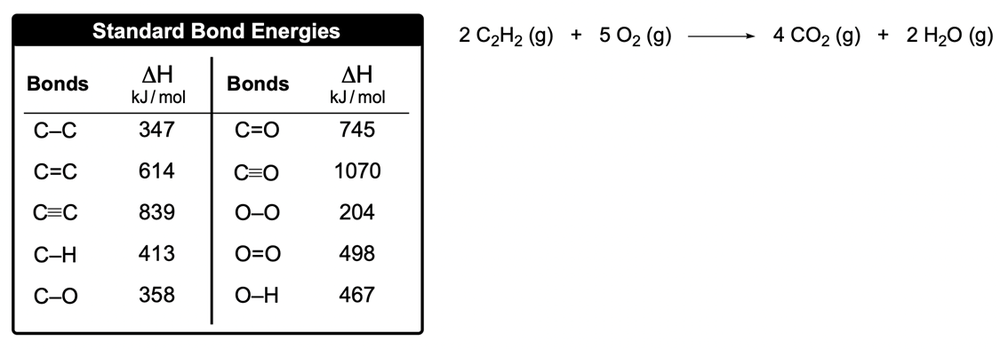
Use the bond energies to estimate the enthalpy of reaction for the combustion of 5 moles of acetylene:
A
-1074 kJ
B
2685 kJ
C
-5020 kJ
D
-430 kJ
5 Comments
Verified step by step guidance
1
Identify the bonds broken and formed in the reaction. For the combustion of acetylene (C₂H₂), the bonds broken are: 2 C≡C bonds and 2 C-H bonds per mole of C₂H₂, and 5 O=O bonds from O₂. The bonds formed are: 8 C=O bonds in CO₂ and 4 O-H bonds in H₂O.
Calculate the total energy required to break the bonds in the reactants. Use the bond energies provided: 2 moles of C≡C bonds (839 kJ/mol), 2 moles of C-H bonds (413 kJ/mol), and 5 moles of O=O bonds (204 kJ/mol). Multiply the bond energy by the number of moles for each type of bond.
Calculate the total energy released by forming the bonds in the products. Use the bond energies provided: 8 moles of C=O bonds (745 kJ/mol) and 4 moles of O-H bonds (467 kJ/mol). Multiply the bond energy by the number of moles for each type of bond.
Determine the enthalpy change for the reaction by subtracting the total energy released from the total energy required. This will give the enthalpy change for the combustion of 2 moles of acetylene.
Since the problem asks for the enthalpy change for the combustion of 5 moles of acetylene, multiply the enthalpy change calculated for 2 moles by 2.5 to find the enthalpy change for 5 moles.


 Verified step by step guidance

