Join thousands of students who trust us to help them ace their exams!
Multiple Choice
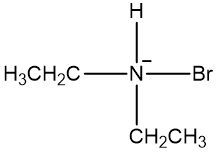
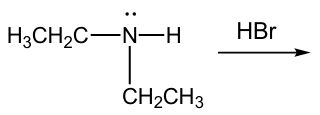
Determine the ammonium ion formed in the following reaction between diethylamine and hydrobromic acid.
A
B
C
D
0 Comments
Verified step by step guidance
1
Identify the reactants: diethylamine (a secondary amine) and hydrobromic acid (HBr). Diethylamine has the structure where a nitrogen atom is bonded to two ethyl groups (CH3CH2-) and one hydrogen.
Understand the reaction type: Amines are basic and can accept a proton (H+) from acids like HBr. When diethylamine reacts with HBr, the nitrogen atom will accept a proton, forming an ammonium ion.
Determine the charge on nitrogen after protonation: The nitrogen in diethylamine has a lone pair that accepts a proton, resulting in a positively charged ammonium ion (N+).
Draw the ammonium ion: The nitrogen will be bonded to two ethyl groups, one hydrogen from the original amine, and one additional hydrogen from the protonation, giving it four bonds and a positive charge.
Match the correct structure: The ammonium ion formed will have the nitrogen with a positive charge, bonded to two ethyl groups and two hydrogens. This corresponds to the structure where nitrogen is positively charged and bonded to H, CH2CH3, and another CH2CH3 group.




 Verified step by step guidance

