What effect do the listed changes have on the position of the equilibrium in the reaction of carbon with hydrogen? C(s) + 2 H2(g) ⇌ CH4(g) ∆H = -18 kcal/mol (-75kJ/mol) b. Increasing pressure by decreasing volume
Verified step by step guidance
1
Identify the type of reaction: The reaction involves gases (H₂ and CH₄) and a solid (C). Since solids do not affect equilibrium, focus on the gaseous species. The reaction converts 2 moles of H₂ gas into 1 mole of CH₄ gas, resulting in a net decrease in the number of gas moles.
Understand the effect of pressure changes on equilibrium: According to Le Châtelier's Principle, if the pressure is increased (by decreasing volume), the equilibrium will shift to the side with fewer gas moles to counteract the change.
Apply the principle to this reaction: The reactant side has 2 moles of H₂ gas, while the product side has 1 mole of CH₄ gas. Since the product side has fewer gas moles, the equilibrium will shift toward the product side (CH₄) to reduce the pressure.
Relate the shift to the reaction's enthalpy: While the enthalpy change (∆H = -18 kcal/mol) indicates the reaction is exothermic, this does not directly affect the shift caused by pressure changes. The shift is determined solely by the number of gas moles in this case.
Conclude the effect: Increasing pressure by decreasing volume will shift the equilibrium position toward the product side, favoring the formation of CH₄ gas.
Verified video answer for a similar problem:
This video solution was recommended by our tutors as helpful for the problem above
Video duration:
1m
Play a video:
Was this helpful?
Key Concepts
Here are the essential concepts you must grasp in order to answer the question correctly.
Le Chatelier's Principle
Le Chatelier's Principle states that if a dynamic equilibrium is disturbed by changing the conditions, the position of equilibrium shifts to counteract the change. In the context of the given reaction, increasing pressure by decreasing volume will favor the side of the reaction with fewer moles of gas, which can help predict how the equilibrium will shift.
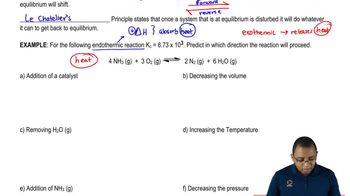
The following is an endothermic reaction where Kc = 6.73 x 10³.For each of the choices below predict in which direction the reaction will proceed
Mole Ratio in Gaseous Reactions
In the reaction C(s) + 2 H2(g) ⇌ CH4(g), there are two moles of hydrogen gas on the reactant side and one mole of methane gas on the product side. Understanding the mole ratio is crucial because changes in pressure affect the gaseous components, and the equilibrium will shift towards the side with fewer moles of gas to reduce the pressure.
The effect of pressure on equilibrium is significant in reactions involving gases. Increasing pressure typically shifts the equilibrium towards the side with fewer gas molecules. In this case, since the product side has one mole of gas (CH4) compared to two moles of gas (H2) on the reactant side, increasing pressure will shift the equilibrium to the right, favoring the production of methane.